Introduction
Cutting concrete block cleanly takes more than muscle. Grab the wrong saw or blade, and you'll end up with cracked blocks, jagged edges, and a pile of wasted material.
Contractors and shop crews run into the same problem: which saw actually fits the job? A one-off block repair doesn't need the same setup as a crew running masonry cuts every day.
This guide covers the main saw types, how to pick the right diamond blade, a step-by-step cutting process, the safety gear you need, and manual options for smaller jobs.
Key Takeaways
- Use a diamond blade with wet cutting for clean, safe concrete block cuts
- Match your saw to the job — handheld tools for occasional cuts, block saws for volume work
- Silica dust from dry-cutting is a serious respiratory hazard; PPE and water aren't optional
- Get the right saw-and-blade pairing from a knowledgeable supplier to avoid waste and rework
Types of Saws for Cutting Concrete Blocks
The right saw depends on three things: how precise the cut needs to be, how thick the block is, and whether you're making one cut or a hundred.
Circular Saw with a Diamond Blade
A standard circular saw becomes a concrete-cutting tool the moment you swap the wood blade for a masonry-rated diamond blade. It's the most accessible option for pavers, blocks, and short wall sections, and most contractors already own one.
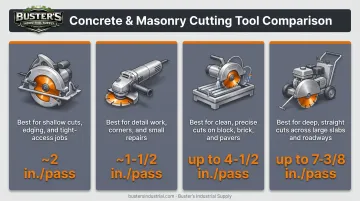
The catch: single-pass depth is limited by the diamond segments themselves, not the saw's full cutting capacity. Manufacturer guidance for handheld masonry cutting often recommends staying around 2 inches per pass, even when the saw's mechanical maximum runs deeper. Thicker blocks need multiple passes, not one deep cut.
Angle Grinder with a Diamond Blade
When a circular saw isn't practical, a diamond-blade angle grinder fills the gap. It's best suited for:
- Detail cuts and notches
- Smaller blocks or partial cuts
- Tight spaces where a circular saw can't maneuver
It's slower and harder to keep perfectly straight, but for one-off jobs it gets the work done without buying additional equipment.
Masonry / Block Saw (Wet Saws)
This is the professional standard. Stationary masonry saws are purpose-built for repeated, precise cuts on concrete and cinder blocks, with far less chipping than a handheld tool produces.
The diamond blade you pair with a wet saw matters as much as the saw itself. Buster's Industrial Supply stocks masonry-rated blades and helps shops match blade specs to block type and cutting volume.
Walk-Behind Saw
Reserved for large-scale or industrial work: block walls, thick slabs, and anything where cut depth pushes past roughly seven inches. At that depth, step-cutting isn't optional; it's how the saw is designed to be used.
For reference, Diamond Products walk-behind specs list depth capacities from 4-3/8 inches with a 14-inch blade up to 7-3/8 inches with a 20-inch blade, depending on the model. Early-entry saws like the CC148HXL-EE6, built for control joints in green concrete, top out around 1-3/16 inches by design. "Walk-behind" does not automatically mean "deep cut."
Selecting the Right Diamond Blade and Cutting Method
Blade type matters just as much as saw type. Get this wrong, and you'll burn through blades fast or end up with a rough, chipped edge.
Segmented, Continuous, and Turbo Rims
| Blade Type | Best For | Trade-Off |
|---|---|---|
| Segmented | General concrete, fast cutting | Rougher finish |
| Continuous rim (flat) | Clean, finish-critical cuts | Slower cutting speed |
| Turbo/corrugated rim | Hard materials, wet or dry use | More aggressive wear |
Segmented blades have open gullets that clear dust and cool the blade as they cut, which is why they're the go-to choice for general concrete block work. Continuous rim blades trade speed for a cleaner edge: better for finish-critical cuts, not high-volume production. Turbo or corrugated rims sit between the two—more aggressive on hard materials and usable wet or dry, but they wear faster.
Wet Cutting vs. Dry Cutting
Wet cutting controls heat and knocks down dust at the source. Dry cutting works, but it demands frequent pauses so the blade and motor don't overheat, and it throws a lot more dust into the air.
NIOSH engineering-control guidance for construction saws recommends roughly half a liter of water per minute at the blade (not more, not less) for effective dust suppression. That's a small amount of water doing a lot of work.
Matching Blade Size to Saw
Buster's organizes blade diameter by saw type:
- 4–5 inches for angle grinders
- 7–9 inches for handheld cut-off saws
- 12–16 inches for walk-behind saws
- 18–36 inches for large floor saws
Common arbor sizes run 20mm and 1 inch, though specialty configurations exist, including 7/8-inch, 60mm, and GC-45 AX fittings for specific saw models. Mismatched arbor size means an unsafe fit. Always check the saw's spec sheet before ordering a blade.
When diameter, arbor, and material ratings get confusing, Buster's Industrial Supply can confirm the blade matches both your saw and the block you're cutting.
Step-by-Step: How to Cut a Concrete Block with a Saw
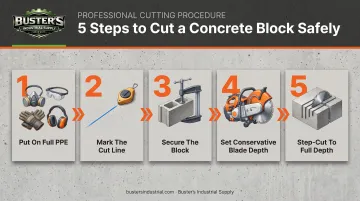
- Put on full PPE. Respirator, hearing protection, gloves, and eye protection go on before the saw powers up, not after the first cut.
- Mark the cut line. Use chalk or a straightedge so the line stays visible once dust starts flying.
- Secure the block. Clamp or brace it firmly. A block that shifts mid-cut can bind the blade and cause kickback.
- Set a conservative blade depth. Make a shallow guide cut along the marked line first.
- Step-cut to full depth. Repeat shallow passes at increasing depth rather than forcing one deep cut.
That last step protects the blade and the block. Diamond Products' operator manuals recommend keeping passes to around 2 inches at a time, even on saws with much greater mechanical depth capacity. Deeper single passes overload the blade and raise the odds of cracking the block.
Safety Precautions When Cutting Concrete Blocks
Concrete dust contains crystalline silica. Breathe enough of it in over time, and it causes permanent lung damage. That risk is a documented occupational hazard on any job site where concrete is cut dry or wet.
Required gear and controls for concrete block cutting:
- NIOSH-rated respirator (N95 or better)
- Hearing protection
- ANSI-rated safety glasses
- Cut-resistant gloves
- GFCI-protected power source for electric saws
OSHA's construction standard sets the permissible exposure limit for respirable crystalline silica at 50 micrograms per cubic meter as an 8-hour average, with an action level of half that. It's a low threshold, which tells you how seriously this needs to be taken on any job site.
If a wet saw isn't available, hosing down the work area during dry cutting helps knock dust down, though it's not a full substitute for integrated water delivery at the blade. Buster's stocks nitrile gloves in bulk for shops that go through PPE regularly. That matters when you're outfitting a whole crew rather than just yourself.
Cutting Concrete Blocks Without a Power Saw
Not every job justifies buying or renting a saw. For occasional small cuts, manual methods still work.
Hammer and chisel:
- Score a shallow line along the cut mark
- Strike repeatedly along that line until the block splits
- Expect a rougher edge than a saw produces
Block splitters:
- Available at most tool rental shops
- Produce faster, more repeatable splits than hammer and chisel
- Still leave a less precise edge than a diamond blade
These methods work fine for a small repair or a few blocks on a punch list. Once you're cutting more than a handful, or need clean edges on a visible wall, a proper saw setup pays for itself fast in labor time and fewer scrapped blocks.
Frequently Asked Questions
What is the best saw for cutting concrete blocks?
A circular saw or angle grinder with a diamond blade works well for small jobs. For frequent or precision cutting, a masonry/block saw is the better long-term investment.
Can you cut concrete blocks with a regular circular saw?
Yes, but only after fitting it with a diamond blade rated for masonry. A standard wood-cutting blade won't cut concrete and will wear out or fail quickly if you try.
Do you need a wet saw to cut concrete blocks?
Not strictly, but it's strongly recommended. Wet cutting controls silica dust and keeps the blade from overheating far better than dry cutting does.
How deep can you cut a concrete block in one pass?
It depends on the blade diameter and rated cutting depth—often a couple of inches per pass. Thicker blocks need multiple shallow passes rather than one deep cut.
Is it safe to cut concrete blocks without a mask?
No. Airborne crystalline silica dust from dry cutting can cause serious, permanent lung damage with repeated exposure. A NIOSH-rated respirator is essential.
How do you cut concrete blocks without cracking them?
Use step-cutting: shallow, repeated passes at increasing depth. Keep the saw moving steadily instead of forcing it through in one deep cut.