Introduction
In manufacturing, profitability usually comes down to one thing: having the right materials, in the right quantity, at the right time. Too little stock and the line stops. Too much and cash sits locked in a warehouse instead of funding growth.
Most shops feel this tension daily. Raw materials, work-in-process, and finished goods have to be tracked across dozens or thousands of SKUs and vendors — often on a spreadsheet someone updates when they remember to.
This guide breaks down what matters for manufacturing inventory:
- Core concepts and a practical five-step inventory process
- Methods worth knowing: FIFO, LIFO, JIT, and ABC analysis
- KPIs that actually move the needle on cost and uptime
- Why your supply partner is part of your inventory strategy whether you've framed it that way or not
Key Takeaways
- Manufacturing inventory spans raw materials, WIP, finished goods, and the MRO supplies that keep equipment running
- A repeatable five-step process connects forecasting, purchasing, tracking, production, and reordering
- FIFO, LIFO, JIT, and ABC analysis solve different problems; none replaces the others
- Inventory turnover, DSI, and fill rate translate stock levels into cash-flow signals
- Supplier reliability directly determines how much safety stock you're forced to carry
What Is Inventory Management in Manufacturing?
Manufacturing inventory management is the process of tracking and controlling materials, components, work-in-process, and finished goods from the moment they're procured until the finished product ships. It touches purchasing, the shop floor, and accounting all at once.
The Three Core Inventory Types
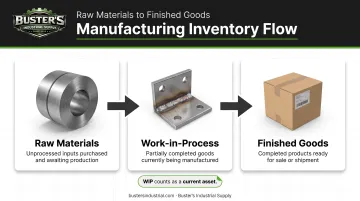
Every manufacturer, from a two-person machine shop to a large fabrication plant, manages three categories:
- Raw materials — steel bar stock, plate, or resin sitting in inventory before production starts
- Work-in-process (WIP) — a partially machined bracket or a weld assembly midway through the shop
- Finished goods — the completed part, ready to ship or sit in the warehouse
Picture a metal fabrication shop cutting and welding steel brackets. Coils of sheet steel are raw materials. Once cut and bent, they become WIP. Once welded, painted, and packaged, they're finished goods.
WIP counts as a current asset for accounting purposes, because it already carries embedded material, labor, and overhead costs, even though it isn't sellable yet.
The Overlooked Category: MRO Supplies
Maintenance, repair, and operations (MRO) items (fasteners, safety gear, cutting tools, consumables) rarely get the same attention as raw materials. That's a mistake. A missing grinding wheel or a depleted box of nitrile gloves can stall a production line just as effectively as a missing steel coil.
Why It Matters to Your Bottom Line
Poor inventory control hits cash flow directly. The Institute for Supply Management notes there's no single industry benchmark. Most companies still target inventory carrying costs between 20% and 30% of total inventory value, covering capital, storage, service, and risk combined.
The goal is a tight balance: enough stock to avoid stockouts, without overstocking and tying up capital in carrying costs, obsolescence, or spoilage.
The 5 Steps of the Inventory Management Process
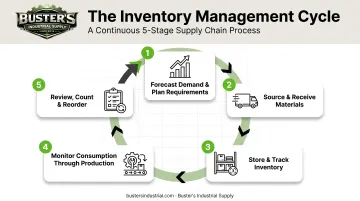
Every business adapts the details, but most manufacturing inventory management follows five repeatable steps that connect purchasing, the shop floor, and accounting into one loop.
Step 1: Forecast Demand and Plan Requirements
This step starts with sales orders, forecasts, or a master production schedule. Compare that against a bill of materials (BOM) to figure out exactly what needs to be purchased or produced, and when.
Step 2: Source and Receive Materials
Send purchase orders to suppliers based on the plan. When goods arrive, inspect them for quantity and quality before logging anything into stock. Skipping this step is how bad parts end up on the shop floor.
Step 3: Store and Track Inventory
Organize received materials into storage locations and track them through SKU, lot, or barcode systems. Real-time visibility here means production planners actually know what's on hand instead of guessing.
Step 4: Monitor Consumption Through Production
Reserve and pick materials for manufacturing orders; they move into WIP (work in progress) as production consumes them. Tracking actual usage against planned usage matters for two reasons: it keeps costing accurate, and it flags process inefficiencies early.
Step 5: Review, Count, and Reorder
Cycle counts or full physical inventories reconcile what you have on hand with the records. That data feeds directly into the next round of purchasing decisions: reorder points, safety stock levels, and supplier scheduling.
Key Inventory Management Methods Manufacturers Should Know
No single method fits every operation. The right mix depends on product type, lead times, and how you produce — make-to-stock, make-to-order, or somewhere in between.
FIFO, LIFO, and Inventory Costing
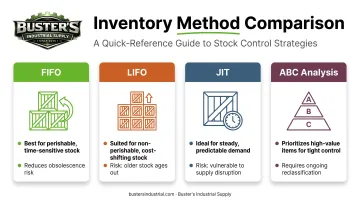
FIFO (first in, first out) assumes the oldest stock is used first. It's the standard for perishable or shelf-life-sensitive goods, and it generally produces lower reported COGS during inflationary periods.
LIFO (last in, first out) assumes the newest stock is used first. Manufacturers sometimes choose it during inflation for tax and cost-recovery advantages, because it matches higher current costs against current sales. U.S. tax rules require LIFO for tax to align with financial reporting.
Just-In-Time (JIT) Inventory
JIT is a lean strategy: keep only what you need to meet immediate demand. It cuts carrying costs, but only when suppliers are highly reliable and responsive.
- Upside: Lower on-hand inventory and less capital tied up in stock
- Risk: Thin buffers leave little room when lead times slip
The 2021 auto industry chip shortage showed the downside clearly. Fragile supply chains plus minimal buffers left plants with almost no way to absorb delays.
ABC Analysis and the 80/20 Rule
ABC analysis applies the Pareto principle to inventory:
- Class A — top ~20% of SKUs; often ~70–80% of inventory value; tightest control and best storage placement
- Class B — mid-tier items requiring moderate oversight
- Class C — low-value, high-count items that need only periodic review
Reorder Point and Safety Stock
The reorder point formula is lead time × average demand + safety stock. It looks simple on paper.
In practice, inconsistent supplier lead times force manufacturers to carry more safety stock than planning models suggest. Inventory efficiency tracks vendor reliability as much as internal forecasting.
Common Inventory Challenges and Best Practices
Three problems show up again and again on the shop floor:
- Demand variability — orders spike or drop faster than forecasts can adjust
- Supply chain disruptions — a single late shipment cascades into missed production dates
- Inventory record inaccuracy — usually caused by manual spreadsheet tracking that falls out of sync with reality
A 2022 McKinsey survey found 80% of companies increased inventory levels in 2021, by an average of 11%, specifically to buffer against disruption. Most expected to keep holding more stock going forward.
Best practices that actually fix these issues:
- Run regular cycle counts instead of waiting for an annual physical inventory surprise
- Use barcodes or simple inventory software to catch discrepancies before they compound
- Build cross-functional collaboration between purchasing, production, and the warehouse
- Review supplier lead-time performance routinely, not just when something goes wrong
Essential Inventory KPIs to Track
Three metrics tell you whether your inventory strategy is actually working.
| KPI | Formula | What It Signals |
|---|---|---|
| Inventory turnover | COGS ÷ average inventory | High = strong sales velocity; low = overstocking or slow-moving SKUs |
| Days Sales of Inventory (DSI) | Average inventory ÷ (COGS ÷ 365) | How many days of stock you're carrying, and how tightly cash is tied up |
| Fill rate / stockout rate | Orders filled completely ÷ total orders | Whether inventory is actually meeting production and customer demand |
For context, APQC's cross-industry benchmark data shows a median inventory turnover of 8.0 turns and a median order fill rate of 94.0%. That figure spans all industries, not manufacturing specifically, so treat it as a general reference rather than a hard target.
Read the metrics in combination:
- Falling turnover with rising DSI usually means capital is stuck in stock that isn't moving
- Fill rate consistently below target points to reorder points set too low, or a supplier that isn't keeping pace
Why Your Supply Partner Is Part of Your Inventory Strategy
Even the best inventory system is only as reliable as the vendors feeding it. Late deliveries, inconsistent quality, or a supplier who's hard to reach throw off your reorder point calculations and force you to carry excess safety stock just to compensate.
Vendor relationships belong in your inventory strategy, not only on the purchasing ledger.
Buster's Industrial Supply works as this kind of partner for manufacturing and shop customers. It's a one-stop shop covering welding equipment, cutting tools, abrasives, and the MRO consumables — lubricants, degreasers, PPE — that tend to get overlooked until they run out. Products range from a $4 drill bit to a $3,299 concrete saw.
Several supplier capabilities support tighter inventory control:
- Fast, personal responsiveness from team members like Jeff and Buster, for first-time buyers and decade-long shop accounts alike
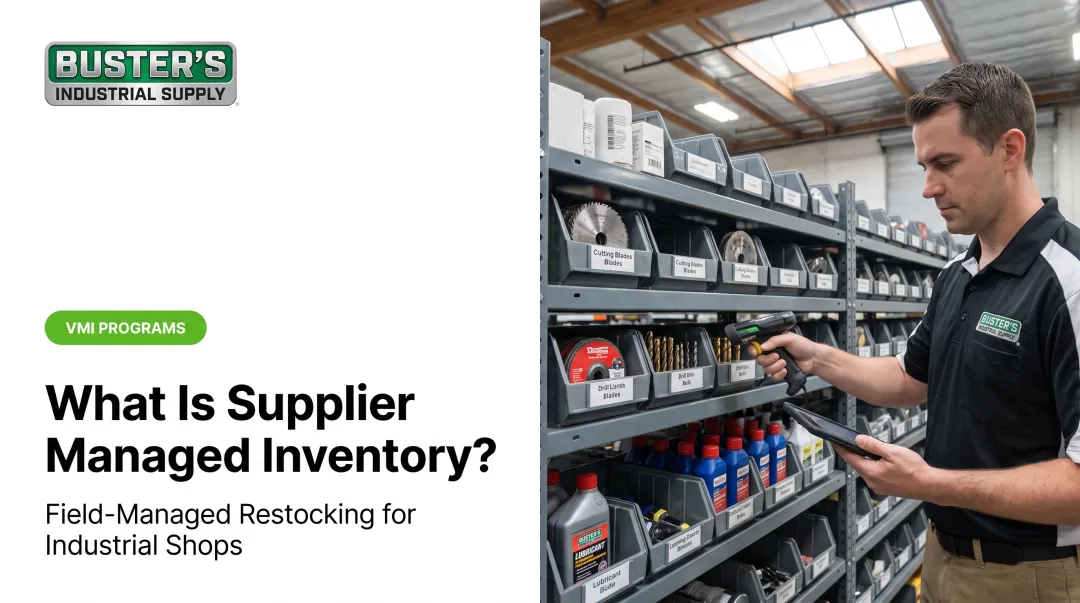
- Vendor-managed inventory that monitors on-site levels, replenishes essentials before stockouts, and shares monthly usage reports
- No minimum order quantity on standard purchases, so you restock to actual usage instead of supplier batch sizes
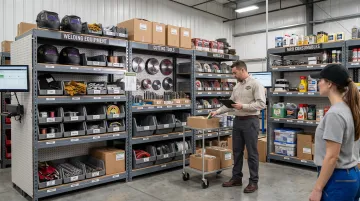
Working with a dependable, communicative supplier supports leaner strategies like JIT by shortening lead times and shrinking the safety stock buffer you need to protect production.
Practical tip: when evaluating industrial suppliers, weigh responsiveness and catalog breadth as heavily as unit price. A fragmented vendor list — five suppliers for five categories — creates more inventory blind spots than one trusted partner who can cover most of what you need.
Frequently Asked Questions
What are the 5 steps of inventory management?
Forecast demand, source and receive materials, store and track stock, monitor consumption through production, then review and reorder. It's a continuous loop, not a one-time process.
What is manufacturing inventory management?
It's the process of tracking raw materials, work-in-progress (WIP), and finished goods so production keeps running without tying up excess capital in stock. It connects purchasing, the shop floor, and accounting.
What is FIFO, LIFO, and JIT?
FIFO uses the oldest stock first and suits perishable goods. LIFO uses the newest stock first, often for tax advantages during inflation. JIT means producing only what's needed to meet immediate demand.
What is the 80/20 rule in inventory?
It's ABC analysis based on the Pareto principle: roughly the top 20% of SKUs (Class A) typically account for 70-80% of inventory value or movement, so they get the most attention.
What is the difference between inventory management and inventory control?
Inventory control focuses narrowly on stock already on-site — quantities, locations, accuracy. Inventory management is broader, covering demand planning, purchasing decisions, and supplier coordination.
How often should a manufacturer perform a physical inventory count?
Run cycle counts weekly or monthly for high-value, fast-moving items, and at least one full physical inventory count annually for complete reconciliation. Frequency should scale with an item's dollar value and turnover.