Penetrating spray matters beyond convenience. The right formula protects fasteners and tools from damage during removal, cuts labor hours on stuck-bolt jobs, and keeps automotive, industrial, and maintenance crews moving. But not every can on the shelf performs the same way.
Independent lab and field tests show real gaps in how much torque different penetrants save when breaking a corroded nut free. That means the cheap can and the premium can aren't always interchangeable. This guide ranks the top penetrating sprays for rust, based on independent testing and real shop use, and covers how to apply them for the best results.
Key Takeaways
- Penetrating spray uses capillary action, solvents, and rust-dissolving additives to free seized parts
- Treat it as routine maintenance, not only an emergency fix
- Loosening performance varies by brand—independent torque tests show real gaps between products
- Factor penetration speed, lubricating residue, price per ounce, and nozzle design into your buy
- Rank top penetrants and apply them correctly to avoid wasted product and downtime
Overview of Penetrating Sprays in the Industrial Maintenance Market
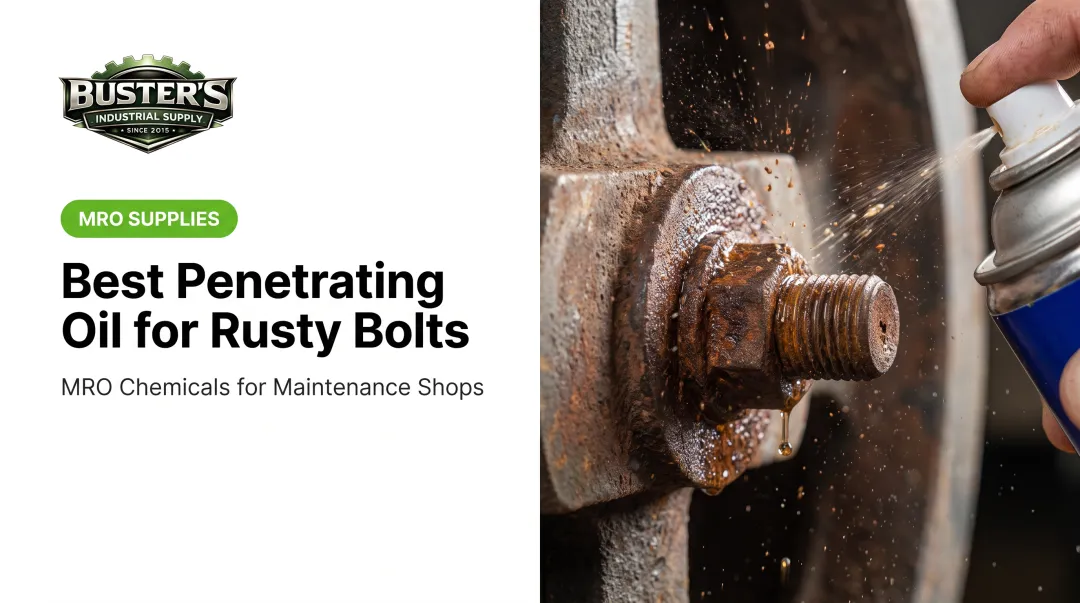
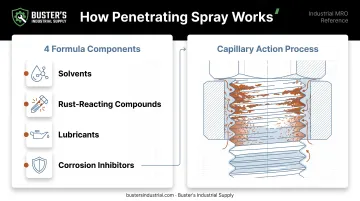
A penetrating spray is a low-viscosity fluid built to seep into corroded threads and free stuck metal parts. The formula typically combines four ingredient groups:
- Solvents (acetone, mineral spirits, kerosene) that thin the mixture so it can flow into tight spaces
- Rust-reacting compounds like citric or phosphoric acid that break down oxidation
- Lubricants, petroleum or synthetic, that reduce friction once the bond loosens
- Corrosion inhibitors that offer short-term protection after application
Capillary action pulls the thinned liquid into microscopic gaps between threads, according to WD-40's technical breakdown of how penetrating oil works. Once inside, solvents and reactants break down rust while lubricant cuts friction so fasteners can turn free.
That performance matters most where corrosion never really lets up. Shops in Texas, Ohio, and California face humidity, road salt, and heavy industrial exposure that attack fasteners year-round. Road salt alone contributes to roughly $5 billion in annual U.S. road-repair costs, according to the EPA's data on winter road-salt damage — a clear marker of how hard that exposure is on hardware and equipment.
Buster's Industrial Supply stocks MRO penetrating lubricants such as Quest PIERCE and Pentrazen 4 Way for shops that deal with recurring rusted fasteners. Below are the top-performing sprays based on independent testing and real shop use.
Top Penetrating Sprays for Rust
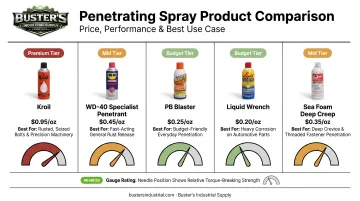
Rankings below weigh penetration speed, loosening-torque performance, lubrication and protection residue, and value per ounce.
Kroil Original Penetrant
Kano Laboratories has manufactured Kroil since 1939, and it's earned a reputation across manufacturing, aviation, and rail as an industrial-grade penetrant rather than a light consumer product. Its formula is built for deep capillary penetration into fine threads and severely seized components, the kind of jobs where a light-duty spray simply won't cut it.
Kroil runs at a premium price point, often landing around $3.00 per fluid ounce in aerosol form at industrial suppliers. For shops facing heavy or long-term rust, that cost is usually justified.
| Spec | Details |
|---|---|
| Best For | Heavy rust, industrial machinery, precision equipment |
| Application | Liquid or aerosol, drip and spray options |
| Notable Trait | Top-tier loosening torque in independent comparison tests |
WD-40 Specialist Penetrant
This is a dedicated penetrant line, separate from the classic WD-40 multi-use spray, engineered specifically for rusted bolts, locks, and hinges. The Smart Straw dual-spray nozzle lets you switch between a pinpoint stream and a wider spray without swapping attachments. That small feature helps on hard-to-reach fasteners.
At roughly $0.50 per ounce, it's one of the more affordable options here, and its brand availability means you can usually find it at any hardware counter in a pinch.
| Spec | Details |
|---|---|
| Best For | General automotive and light industrial rust removal |
| Application | Aerosol with adjustable straw nozzle |
| Notable Trait | Widely available; moderate torque reduction in lab comparisons |
PB Blaster
PB Blaster has been a staple in U.S. auto repair and industrial shops for decades. The formula is fast-acting, and it consistently shows up as a strong rust-breaking option in torque-load comparisons without carrying a premium price tag.
Priced around $0.54 per ounce, it lands in the same affordable tier as WD-40 Specialist Penetrant, but with a reputation for slightly quicker rust-breaking action on stubborn exhaust bolts and suspension hardware.
| Spec | Details |
|---|---|
| Best For | Rusted exhaust bolts, suspension components, fasteners |
| Application | Aerosol spray can |
| Notable Trait | Strong results in published torque-load comparisons |
Liquid Wrench
Liquid Wrench punches above its price class for garage and shop work. At around $1.41 per ounce, it costs less than Kroil. In a six-way independent test run by Project Farm, it beat premium competitors including AeroKroil, WD-40, and PB Blaster on torque-loosening.
For high-volume shops buying penetrant by the case, that combination of performance and cost per ounce is hard to beat.
| Spec | Details |
|---|---|
| Best For | Cost-conscious shops needing bulk penetrant supply |
| Application | Aerosol or squirt-can liquid |
| Notable Trait | Premium-level loosening at a much lower price per ounce |
Sea Foam Deep Creep
Deep Creep is Sea Foam's penetrant offshoot, and mechanics favor it for rust-breaking and moisture displacement on outdoor and marine equipment. It combines penetration with corrosion inhibition, which makes it a solid pick for parts that live outside: trailer hitches, marine hardware, and farm equipment exposed to weather and road salt.
At roughly $0.83 per ounce, it sits comfortably mid-pack on price while offering weather-specific advantages the other products here don't emphasize as strongly.
| Spec | Details |
|---|---|
| Best For | Outdoor equipment, marine hardware, weather-exposed fasteners |
| Application | Aerosol spray can |
| Notable Trait | Rust-breaking plus moisture displacement for weather-exposed parts |
How to Apply Penetrating Spray for Best Results
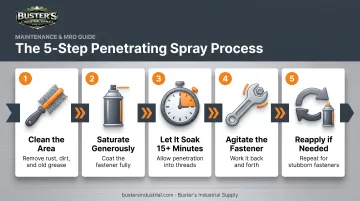
Even the best penetrant underperforms if it's applied wrong. Follow this sequence:
- Clean the area first. Wipe away loose dirt, grease, and debris around the fastener so the spray reaches the threads directly instead of pooling on grime.
- Saturate generously. Don't just mist it: soak the joint so the oil has enough volume to work its way in by capillary action.
- Let it soak. Give it at least 15 minutes. Heavily rusted components may need up to an hour, or repeated soak-and-reapply cycles for severe cases.
- Agitate the fastener. Light tapping or working it back and forth by hand helps break the rust bond before you apply full torque with a wrench.
- Reapply if needed. If the fastener still won't budge, add more penetrant and repeat the soak.
Safety note: Most penetrating sprays are flammable aerosols. Before you spray:
- Work in a well-ventilated area, away from open flames or sparks
- Wear gloves and eye protection
- Check the product SDS, especially near painted, rubber, or plastic surfaces
How We Chose the Best Penetrating Sprays
A common mistake is assuming any all-purpose lubricant performs like a dedicated penetrant. Independent torque testing shows that's rarely true — general-purpose oils and true penetrants aren't built for the same job.
We evaluated products across four factors:
- Seepage and capillary speed — how fast the product visibly moves into rusted threads
- Torque required to loosen a rusted fastener — the real measure of performance, not just marketing claims
- Residual corrosion protection — whether the product leaves any meaningful rust-inhibiting film behind
- Cost per ounce — critical for shops burning through cans regularly
For industrial and fleet buyers, raw lab performance isn't the whole story. Consistent bulk availability and vendor reliability matter just as much. A product that tests well but takes three weeks to restock doesn't help a shop mid-job.
That supply reality is why Buster's Industrial Supply backs penetrating lubricants with tiered volume pricing and vendor-managed inventory (VMI) for accounts that need repeat stock, not one-off cans.
Conclusion
Choosing the right penetrating spray means matching formula strength and cost to your actual rust problem. A precision machine shop dealing with fine-thread fasteners has different needs than a fleet operator fighting road-salt corrosion on undercarriage bolts.
Test small batches before standardizing on one product shop-wide. Track how often you're reapplying, and calculate real cost-per-use rather than just the price on the can.
If you're managing penetrating sprays and MRO supplies at scale, Buster's Industrial Supply can help source the right products in the right quantities, including case and bulk options, plus GSA-eligible pricing for government and institutional accounts. Team members like Jeff and Buster are known for being responsive when a shop needs product fast, not three weeks from now.
Frequently Asked Questions
What is the best penetrating spray?
Independent torque tests generally rank industrial-grade penetrants like Kroil highest for breaking severe rust. Liquid Wrench and PB Blaster offer strong performance at a noticeably lower cost per ounce.
Is WD-40 a good penetrating oil for rust?
WD-40's dedicated Specialist Penetrant line performs adequately on light-to-moderate rust. In published comparison testing, it tends to rank mid-pack against dedicated industrial penetrants.
How long should you let penetrating oil soak before removing a bolt?
Most penetrants need at least 15 minutes to work. Heavily rusted fasteners sometimes require an hour, or multiple soak-and-reapply cycles over a day or two.
Can you make your own penetrating oil at home?
A 50/50 mix of automatic transmission fluid and acetone is a well-documented DIY alternative that performed competitively in independent testing. Commercial products remain the safer choice around paint, rubber, and plastic.
What's the difference between penetrating oil and regular lubricant?
Penetrating oil has lower viscosity so it can flow into tight threads and dissolve rust. Regular lubricants are thicker and built mainly for ongoing friction reduction, not rust removal.
Does penetrating oil prevent rust from coming back?
Most penetrants include corrosion inhibitors that offer some short-term protection. For long-term rust prevention, you'll need a dedicated corrosion-inhibiting coating instead.