
Introduction
Grab the wrong bit, and a five-minute hole turns into a snapped shank, an off-center pilot, or a bracket you now have to scrap and recut.
Bit choice affects more than convenience. It drives fabrication cost and shop downtime from broken bits, and it decides whether a bolted angle iron connection holds tight and square.
This guide breaks down drill bit anatomy, the selection factors that matter, and how to match a bit to the specific angle iron job in front of you.
Key Takeaways
- Match point angle, bit material, and diameter to the steel grade and hole spec, not habit
- 118° HSS bits handle standard mild steel angle; 135° split-point cobalt bits handle galvanized or stainless angle
- Center-punching, clamping, and cutting fluid matter just as much as the bit itself
- The right bit reduces breakage, redrilling, and work-hardening on repeat fabrication runs
What Is a Drill Bit for Angle Iron?
A drill bit for angle iron is a twist bit ground and selected to cut cleanly through the leg or corner of mild steel, galvanized, or stainless angle without excessive heat or wander.
Three materials and one tip geometry cover most angle iron work:
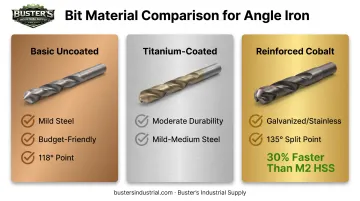
- Standard HSS — general-purpose, suited to mild steel
- Cobalt (M35/M42) — added heat resistance for tougher or coated steel
- Titanium-coated HSS — reduced friction, longer life on ferrous metal
- Split-point tip — self-centering geometry that resists walking
Skip masonry and carbide-tipped bits. Despite what some online forums suggest, carbide-tipped bits are ground for concrete and masonry, not steel, and they'll dull or chip fast on angle iron.
Point Angle
The point angle at the tip is the single biggest factor in how a bit starts a hole.
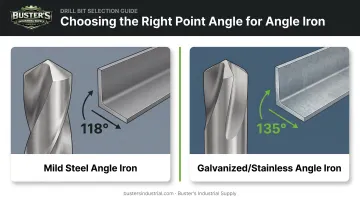
- 118° is the standard, keen-cutting angle for mild steel angle iron — it's what most general-purpose HSS bits ship with
- 135° split-point bits center themselves on contact and resist wandering on harder galvanized or stainless angle
Milwaukee's cobalt line uses a 135° split point for a precision start that prevents walking in hard metal. That self-centering behavior matters more on angle iron than on flat stock, since the corner geometry gives a bit less surface to grip before it bites.
Flute and Helix Design
Helix angle controls how fast chips clear the flutes. On angle iron, chips that pack into the tight inside corner generate heat fast.
A standard 25-35° helix suits most mild steel angle drilling. Faster material removal calls for a steeper helix; some cobalt bits use a variable helix design to pull chips out quicker under load.
Bit Material and Coating
HSS is sufficient for standard mild steel angle. It's affordable, widely stocked, and holds an edge fine at moderate speeds.
Galvanized coatings and stainless angle are a different story. The zinc layer on galvanized steel and the work-hardening tendency of stainless both chew through standard HSS faster. Cobalt or titanium-coated bits earn their higher price through added hardness and heat resistance at the cutting edge.
Benefits of Using the Right Drill Bit for Angle Iron
Matching the bit to the job pays off in ways you can measure on the shop floor:
- Fewer snapped bits mid-job, meaning less downtime swapping tooling
- Cleaner, burr-free holes that seat bolts properly for a secure connection
- Faster cycle times on batch fabrication runs, so more pieces leave the shop per shift
- Reduced heat buildup, which prevents work-hardening around the hole
- Longer tool life, which lowers your cost per hole over time
What to Consider When Choosing the Best Drill Bit for Angle Iron
The right bit depends on the angle iron's material grade, wall thickness, and the tolerance the finished hole needs to hit. These factors tie directly to shop-floor outcomes: bit lifespan, hole accuracy, and downtime.
Material Grade of the Angle Iron
Mild steel, galvanized, and stainless angle each demand different bit hardness and point angle.
- Mild steel (A36) — standard HSS, 118° point, minimal fuss
- Galvanized — zinc-iron layers from hot-dip galvanizing run harder than the base steel; cobalt or split-point bits resist early dulling
- Stainless — work-hardens fast under heat, so cobalt with a 135° split point is the safer call
Point Angle: 118° vs. 135°
A standard 118° point suffices on clean mild steel angle where you're punching a mark first anyway. A 135° split point earns its keep on tougher or coated angle iron, where wandering costs you accuracy and rework.
Bit Material: HSS vs. Cobalt vs. Titanium-Coated
This is a cost-versus-durability call. High-volume shops drilling angle iron daily save money long-term on cobalt, even at a higher upfront price, because fewer bits break and fewer get swapped mid-run.
Titanium-coated HSS sits in the middle: more wear resistance than plain HSS on mild steel, though cobalt still holds up better on stainless and coated angle.
Buster's stocks both ends of that range. Black & Gold HSS jobber bits (1/16"–1/2") cover general mild steel work, while M35 cobalt jobber bits — 5% cobalt, 135° split point — are rated up to 30% faster than conventional M2 HSS bits on tougher material.
Hole Size and Bit Diameter Range
Bit diameter needs to match the bolt or fastener spec used in the bracket or frame, not just "close enough."
The 2020 RCSC structural bolting specification sets standard hole sizes at bolt diameter plus 1/16 inch for bolts up to 1 inch, and bolt diameter plus 1/8 inch above that. A 5/8-inch bolt, for example, calls for an 11/16-inch standard hole. Undersize the bit and you'll fight the fastener; oversize it and you lose clamping tolerance.
Drilling Equipment Compatibility
A hand drill, drill press, and magnetic drill all bring different rigidity to the cut, and rigidity affects which bit geometry performs best. Less rigid setups benefit more from a self-centering split point, since there's more room for the bit to drift before it bites.
Coolant and Lubrication Needs
Heat concentrates right at the bend of angle iron, where chip clearance is toughest. Bit coating and cutting fluid use directly affect how long a bit lasts through that corner.
Buster's carries penetrating lubricants and cutting oils, including Pentrazen 4-Way and ZenaTuff, that shops keep on hand for metalworking tasks like this. A quick application at the start of a hole and again halfway through cuts friction meaningfully on deeper holes.
How Buster's Industrial Supply Can Help
Buster's stocks the HSS, cobalt, and titanium-coated bits fabrication shops need for angle iron work. The team helps you match bit type and point style to your material and volume so you are not guessing off a shelf.
Team members like Jeff work with startups and long-established shops to recommend the right setup for the job at hand.
What you get when you order:
- One-stop ordering for bits, cutting fluid, clamps, and safety gear
- Fair pricing on bulk and repeat orders, with tiered volume discounts
- Fast fulfillment, including urgent mid-job restocks
- 10+ years of hands-on expertise supporting shops across multiple states
Conclusion
Buy the bit matched to your angle iron's grade, the hole specs you need, and the volume you're running—not whatever's most popular on the shelf.
Get that match right, and you'll see fewer broken bits, fewer redrilled holes, and less unplanned downtime.
Revisit that match whenever the job changes, too. Shifting from mild steel to galvanized or stainless angle iron means shifting your bit choice right along with it.
Frequently Asked Questions
What is the best way to drill holes in angle iron?
Center-punch your mark, clamp the workpiece securely, and use a point angle suited to the steel grade. Apply cutting fluid throughout to prevent heat buildup and extend bit life.
What type of drill bit is best for angle iron?
Standard HSS handles mild steel angle just fine. Galvanized or stainless angle calls for a cobalt or titanium-coated split-point bit to resist heat and wear.
Do I need cutting oil when drilling angle iron?
Yes, especially on deeper or larger holes. Cutting fluid reduces friction and heat, which extends bit life and improves the finish of the hole.
What size drill bit should I use for angle iron bolt holes?
Match the bit diameter to your fastener spec. Clearance holes typically run slightly larger than the bolt diameter, while tapped holes require a smaller pilot size.
Can a regular twist drill bit work on angle iron, or do I need something special?
A standard 118° HSS twist bit works fine on mild steel angle. Tougher or coated angle iron benefits from a split-point cobalt bit instead.
Why does my drill bit keep wandering on angle iron?
Skipping the center punch, using a dull bit, or drilling an unclamped workpiece are the most common causes. Fix those three first before blaming the bit itself.