Stuck grease fittings aren't just annoying. Ignore one long enough, and the bearing or bushing behind it runs dry, wears out, and turns a $12 fitting problem into a much bigger repair bill.
This guide breaks down why grease fittings seize or clog, how penetrating oil solves the problem, and the right technique for applying it without stripping threads or blowing seals.
Key Takeaways
- Penetrating oil frees rusted fittings and hardened grease—but it does not replace regular greasing
- Stuck fittings usually mean rust, dried grease, or debris jamming the ball check valve
- Slow soaking beats force: rushing strips threads or cracks housings
- Match the oil to the job (metal, plastic, food-grade) so you fix the fitting without creating new problems
What Is Penetrating Oil and Why Do Grease Fittings Get Stuck?
Penetrating oil is a low-viscosity blend of solvents and lubricants. The solvent thins the mixture so it can wick into microscopic gaps through capillary action, while the lubricant coats surfaces once it arrives.
WD-40's technical breakdown of how penetrating oil works confirms this mechanism: solvents and reactants break down rust while additives leave behind a protective, corrosion-inhibiting film.
That thin consistency is what standard grease can't match. Grease is thick by design. It's built to stay put and cushion moving metal, not squeeze into a rusted thread pitch.
Why Grease Fittings Seize or Clog
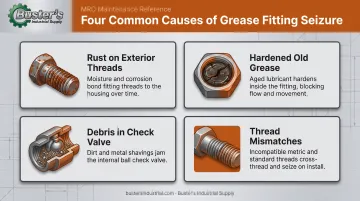
A few culprits show up again and again:
- Rust on the exterior threads — moisture and airborne grit settle on outdoor or heavy-duty equipment, corroding the fitting's nipple and base
- Hardened old grease — grease that sits too long dries out and blocks the joint or pin groove
- Debris in the check valve — dirt or dried grease particles jam the spring-loaded ball that's supposed to open under pressure
- Thread mismatches — an incorrectly sized replacement fitting can leak or bind against the mating component
Vibration and temperature swings common in manufacturing environments don't help. They accelerate wear on seals and joints, giving contaminants more opportunities to work their way in.
How Penetrating Oil Frees a Stuck Fitting
Because it's thin, penetrating oil travels where grease can't : into the thread seams and down to the check valve seat. Once there, it softens hardened grease and breaks the bond rust forms between metal surfaces.
One important distinction: penetrating oil frees the seized mechanism. It doesn't replace the job grease does. Products like CRC's penetrant line are formulated to permeate rust, scale, and gum quickly, not to provide the long-term film strength a bearing needs under load. Once the fitting frees up, get grease back into it.
Signs Your Grease Fitting Needs Penetrating Oil Treatment
Not every stubborn fitting needs the same fix. Here's how to tell penetrant will help versus when you're looking at a replacement job.
Grease won't go in, or it bleeds back out. This is the classic clog symptom. LockNLube's guide to clogged fittings points to back pressure and a hard-to-release coupler as the giveaway signs of a blocked flow path.
Visible rust or a crusted nipple. If the fitting head looks corroded or caked, that buildup is likely extending into the threads too.
The fitting spins freely with zero resistance. This often means the threads themselves are stripped. No amount of soaking fixes worn-out threads — at that point, replacement is the faster, cheaper fix.
A quick way to sort these out:
| Symptom | Likely Cause | Best Fix |
|---|---|---|
| Grease bleeds back around fitting head | Clogged check valve or joint | Penetrating oil + gentle pumping |
| Rust or crust on nipple | Surface corrosion | Wire brush + penetrant soak |
| Fitting spins with no resistance | Stripped threads | Replace the fitting |
How to Apply Penetrating Oil to a Seized Grease Fitting: Step-by-Step
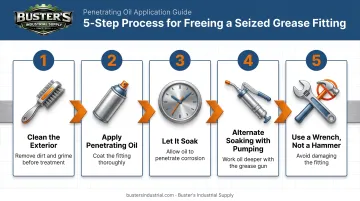
Rushing this process is how fittings get damaged. Work through it in order:
- Clean the exterior first. Wipe away loose dirt, then use a wire brush to knock off surface rust. You want the oil reaching bare metal, not fighting through grime.
- Apply penetrating oil generously. Coat the fitting head and the threaded base where it meets the housing. Cover every visible seam.
- Let it soak. Light surface rust may only need 15 to 30 minutes. Heavier corrosion can take several hours, sometimes overnight with a second or third application in between.
- Alternate soaking with gentle pumping. A few light squeezes on the grease gun between soaks helps work the oil into the check valve without forcing debris further in.
- Use a wrench for stuck housings — not a hammer. If the fitting itself is frozen in place, apply steady, controlled torque. Repeated hammering cracks housings or snaps fittings clean off.
Safety note: Most penetrating oils are flammable solvents. Work in a ventilated area, away from open flames, pilot lights, or grinding sparks.
Choosing the Right Penetrating Oil for Grease Fittings
Not all penetrants are built the same, and picking the wrong one causes new headaches: residue that repels grease, or a solvent that eats through a nearby rubber seal.
What to look for:
- Strong capillary action for tight thread gaps
- Rust-dissolving chemistry, not just a light lubricant coating
- A dry or low-residue finish that doesn't interfere with fresh grease going in afterward
Aerosol vs. drip application: Aerosol sprays work best on overhead or hard-to-reach fittings where you need reach and a directed stream. Drip or pinpoint applicators give you more control for a targeted soak on accessible fittings.
Buster's Industrial Supply carries several options depending on the job:
- Zenex Pentrazen 4 Way (16oz, $10.38) — a four-way penetrant for rust, moisture displacement, and corrosion protection
- Zenex ZenaTuff (20oz, $9.46) — PTFE-enhanced with a 360-degree valve for spraying at any angle
- Quest PIERCE (16oz, $10.77) — non-flammable, non-conductive, rated to 30,000 volts for use near electrical components
- Quest ULTRA TAC ($14.67) — sprays as an oil, then thickens into a viscous grease-like film for lasting protection
Food-Grade and Material-Compatible Options
Fittings on food-processing lines need special handling. NSF's guidance on food-grade lubricant categories explains that H1-rated products are formulated for incidental food contact under strict limits, while standard industrial (H2) lubricants aren't.
Buster's stocks Quest Pen Ease, an NSF H1-registered penetrating oil built for meat-packaging equipment, filling lines, and other food-contact machinery.
For fittings near rubber seals or plastic housings, Quest Sili Lube Heavy Duty Silicone Spray ($13.35) is a safer bet. It's documented safe on metal, rubber, and plastic and handles temperatures up to 400°F.
Team members like Jeff and Buster field these questions daily. They match startups and long-running shops to the formula that fits their equipment, not a generic can off the shelf.
Common Mistakes and Preventive Maintenance Tips
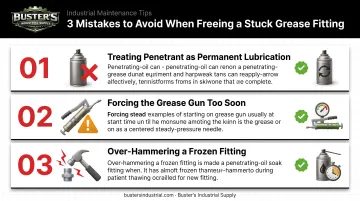
Mistakes to Avoid When Freeing a Stuck Fitting
- Treating penetrant as permanent lubrication. It evaporates and offers no lasting rust protection. Grease it properly once the fitting frees up.
- Forcing the grease gun too soon. Pumping hard before the oil has softened the clog can blow a seal or strip the threads you're trying to save.
- Over-hammering a frozen fitting. A few sharp taps can help vibration work the oil in. Repeated heavy blows crack housings or snap fittings off entirely.
Preventing Future Seizing
- Stick to a greasing schedule. Regular use keeps the check valve moving and prevents old grease from hardening in place.
- Use fitting caps or dust covers. Keep grit out of fittings on equipment that sits outdoors or in dirty environments between service intervals.
- Wipe down fittings periodically. Apply a light rust inhibitor on machinery stored outside or in humid shops.
Frequently Asked Questions
What is a grease buster?
A grease buster is a tool, not a chemical. It's typically loaded with penetrating oil and uses tapping or vibration to work fluid into a clogged fitting, distinct from spraying penetrant directly onto the fitting head.
Can I use WD-40 instead of penetrating oil on grease fittings?
Standard WD-40 Multi-Use Product is a light lubricant with some rust-fighting properties, but it's not formulated as a dedicated penetrant. For heavily rusted or seized fittings, a purpose-built penetrating oil works faster and more thoroughly.
How long should I let penetrating oil sit before greasing?
Light surface rust often loosens in 15 to 30 minutes. Heavier corrosion may need several hours, or an overnight soak with repeat applications in between.
Why won't my grease fitting take grease even after cleaning it?
Cleaning only addresses the exterior. A jammed internal check valve or worn threads inside the fitting usually needs more soak time, or the fitting needs replacing altogether.
Can penetrating oil damage rubber seals or plastic parts near grease fittings?
Some solvent-based penetrants can degrade rubber or plastic over repeated exposure. For equipment with nearby elastomer or plastic components, choose a PTFE- or silicone-based formula instead.
How often should grease fittings be serviced to avoid seizing?
There's no universal number. Service frequency depends on load, speed, temperature, and contamination levels. Set a schedule based on your equipment's usage and inspect fittings visually for early rust or crusting between services.