Contractors blame a shaky hand or a rushed cut, but the real culprit is often a blade that never matched the paver material in the first place. Concrete pavers, clay brick, and natural stone all wear diamond blades differently, and a mismatch shows up fast: chipped edges, slower cuts, and blades that glaze over or burn out mid-job.
Blade choice affects more than the finished edge. It determines cut speed, how much material you waste on bad cuts, and how often you're stopping to swap a worn-out blade instead of running your saw.
This guide breaks down the blade types built for paver work, the buying factors that actually matter, and how to match a blade to your specific job before you make the first cut.
Key Takeaways
- Choose segmented or turbo diamond blades over general-purpose blades for concrete, brick, and stone pavers
- Match blade type to paver hardness, wet vs. dry cutting, and saw compatibility
- Skip concrete-only blades by default—paver abrasiveness varies too widely for a one-size fit
- Buster's Industrial Supply helps contractors match blade type, size, and bond hardness to their specific job
What Is a Diamond Blade for Cutting Pavers?
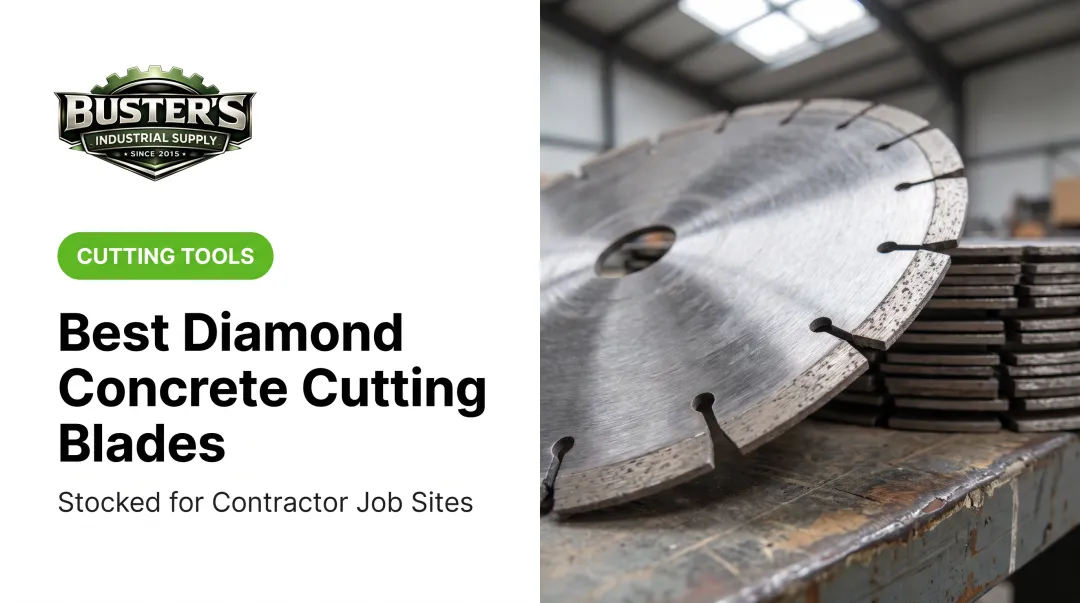
A diamond blade is a steel disc with diamond-embedded segments bonded around the rim. Those segments grind through hard, abrasive materials like concrete, brick, and stone rather than slicing them the way a wood blade cuts lumber.
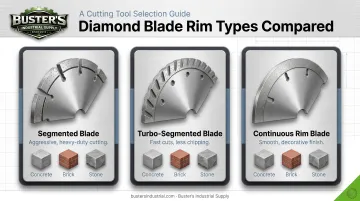
For paver work, three rim styles matter most:
- Segmented blades — gapped segments for aggressive, heavy-duty cutting
- Turbo-segmented blades — a wavy, continuous-looking rim that cuts faster with less chipping
- Continuous rim blades — solid edge for smooth, decorative cuts on finish-sensitive stone
Core and Rim Design
The steel core is the blade's backbone. A thicker, precision-ground core resists flexing at speed, stays flat during long cuts, and pulls heat away from the segments. A weak or warped core leads to wandering cuts and premature segment loss.
The gaps between segments, called gullets, let air or water flow through the cut. That clears debris and keeps the blade from binding or overheating. Wider gullets generally mean more aggressive, faster cutting, though edge smoothness takes a hit.
Bond Matrix & Diamond Concentration
The bond matrix is the metal that holds the diamonds in place, and it has to erode at the right rate. According to Norton's guide to diamond blade fundamentals, hard, abrasive stock needs a harder-wearing bond, while hard but less-abrasive material needs a softer bond that wears away to expose fresh diamond.
Mismatch the bond, and you'll either glaze the blade (too hard) or burn through it too fast (too soft).
Why Segmented and Turbo Blades Suit Pavers Best
MK Diamond's blade overview notes that turbo rims deliver fast cuts with minimal chipping across brick, stone, and concrete, while segmented gullets improve cooling through better air and water flow. For paver contractors, that means:
- Cooler runs with less binding and segment loss
- Cleaner edges with less chipping and wasted material
- Faster cuts that shorten labor hours per job
- Wet or dry use depending on site water access
Buster's Industrial Supply stocks the Diamond Products Panther Twister 14" X-Turbo Combo Blade ($144.18) for this mix of speed and durability. It runs a 0.125-inch kerf, a 1-inch arbor compatible with 20mm fittings, and a bond matrix built to resist glazing on abrasive brick and block.
What to Consider When Choosing the Best Diamond Blade for Cutting Pavers
Paver jobs vary by material, saw, and site conditions, so there's no single "best" blade. Each factor below connects directly to cost-per-cut, downtime, and how clean your finished edges look.
Paver Material & Hardness
Concrete, clay brick, and natural stone pavers each demand different bond hardness. Get the bond wrong, and blade wear accelerates fast, which drives up your cost-per-cut over the life of a project.
Wet vs. Dry Cutting Capability
Wet cutting runs cooler and controls dust. Dry cutting is more convenient when there's no water source on site.
OSHA's Table 1 guidance requires continuous integrated water for handheld, walk-behind, and stationary masonry saws to manage silica exposure, per its respirable crystalline silica publication. A dry rating on a blade doesn't waive those exposure-control duties.
Blade Diameter & Arbor Size
Blade size has to match your saw. Buster's carries:
- 4–5-inch blades for angle grinders (7/8"-5/8" arbor)
- 12–16-inch blades for walk-behind saws (20mm or 1-inch arbor)
- 18–26-inch blades for larger walk-behind equipment (1-inch arbor)
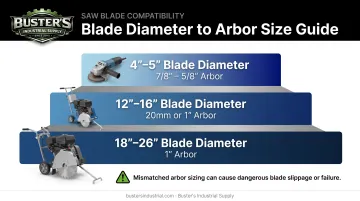
Mismatched sizing throws off cutting depth accuracy and creates a real safety risk.
Segment/Rim Type
Turbo segments generally win on speed and finish quality. Standard segmented blades still hold the edge for heavy-duty dry cutting where raw aggression matters more than a polished cut. The choice affects both edge-chipping rates and how fast you move through material.
Diamond Concentration & Bond Quality
Higher-grade blades cost more upfront but mean fewer blade swaps mid-project. Buster's lineup illustrates the range:
- 14" General Purpose blade: $44.50
- Premium Laser Welded version: $58.77
- Premium cured-concrete blade: $69.85
That spread matters when you're calculating total blades-per-project cost against a deadline.
Saw Horsepower & RPM Compatibility
Every blade carries a maximum operating speed, and exceeding it creates faster wear and a real safety hazard. Norton's dos and don'ts guide is direct on this: match shaft diameter, flanges, and RPM rating to your saw, and never exceed the blade's rated speed.
Diamond Blades for Pavers vs. Concrete: What's the Difference?
Concrete-only blades typically run a softer bond tuned for general reinforced concrete. Pavers demand more from a blade because brick, natural stone, and concrete units vary widely in abrasiveness.
A dedicated paver or multi-purpose blade usually outperforms a concrete-specific blade on mixed materials. Segment design and bond hardness are built for that variability, so you get cleaner cuts and longer life across different paver types.
Here's the trade-off in plain terms:
| Blade Type | Best For | Risk If Misused |
|---|---|---|
| Concrete-only | Reinforced slab, general concrete | Chips brick/stone edges, wears fast on abrasive pavers |
| Multi-purpose combo | Mixed pavers, brick, stone, concrete | Slightly less specialized on pure reinforced concrete |
| Turbo-segmented | Speed + clean edges on paver units | Not ideal for the heaviest dry demolition work |
A concrete-only blade will technically cut a paver. It'll just do it slower, rougher, and with a shorter blade life than one built for that mix of materials. The Panther Twister and similar combo blades exist specifically to bridge that gap.
How Buster's Industrial Supply Can Help
Matching a blade to a paver job means weighing material, saw type, arbor size, and bond hardness all at once. That's a lot to get right on a bid deadline. Buster's Industrial Supply stocks segmented and turbo diamond blades built for this work so contractors can skip the guesswork.
Team members like Jeff, Buster's Team Lead and Sales Representative, know blade specs from the field. They help match diameter, arbor, and bond to your paver project anywhere Buster's serves across the U.S.
What contractors get from Buster's:
- One-stop shop for blades, walk-behind saws, and replacement accessories
- Fast, reliable service for urgent job-site needs, with most orders shipping in 1–2 business days
- Fair, competitive pricing across blade grades and sizes
- Long-term vendor relationships built on responsiveness, including on-site restocking for shops and job sites

If you're not sure whether your next paver job calls for a Panther Twister X-Turbo or a straight concrete blade, Buster's team can walk you through the choice.
Conclusion
Match your diamond blade to the paver material, the saw, and the site conditions you're working with.
Blade choice drives cost-per-cut, edge quality, and how safely your crew runs that saw all day. When paver materials or job scope change, revisit your selection instead of defaulting to whatever worked last time.
A supplier who understands bond hardness and rim geometry is worth consulting when the specs get complicated.
Frequently Asked Questions
What type of diamond blade is best for cutting pavers?
Segmented or turbo diamond blades handle concrete, brick, and stone pavers best while resisting the overheating that chips edges.
What is the best tool to cut pavers with?
A circular saw, angle grinder, or walk-behind saw fitted with the correct diamond blade is the standard setup for clean paver cuts, depending on job scale.
What type of diamond blade is best for cutting concrete?
Segmented diamond blades with a bond matched to the concrete's hardness cut most efficiently and with less wear.
Can you cut pavers with a regular concrete blade?
Yes, but it often wears faster or chips edges since paver materials vary in abrasiveness compared to standard reinforced concrete.
Do you need water to cut pavers with a diamond blade?
Wet cutting reduces heat and dust, but many segmented blades, like the Panther Twister X-Turbo, are rated for both wet and dry cutting.
How long does a diamond blade last when cutting pavers?
Lifespan depends on material hardness, blade quality, and cutting method. A well-matched blade can last through hundreds of cuts.