The stakes are climbing, too. The global welding equipment market sits at $22.22 billion in 2025 and is projected to grow to $38.05 billion by 2034, according to a 2026 report from Fortune Business Insights. That's a 6.16% annual growth rate, and it reflects how much manufacturing, construction, and repair work still depends on reliable welding power.
This guide breaks down the brands worth buying in 2026, how to evaluate them, and what actually matters when duty cycle and downtime affect your bottom line.
TL;DR
- Prioritize duty cycle and inverter vs. transformer tech over brand loyalty or sticker price
- Compare industrial leaders (Lincoln, Miller, ESAB) with mid-range picks (Hobart, Everlast)
- Weigh certifications, service networks, and total cost of ownership—not just upfront price
- Partner with an industrial supplier to match brand and model to your shop's real workload
Overview of Welder Brands in the Industrial & Fabrication Market
A welder brand's reputation signals more than name recognition. It tells you about build quality and how easy it is to find replacement parts. It also signals whether a dealer network exists when something breaks mid-project. For a hobbyist, that's a nice-to-have. For a business running multiple shifts, it's the difference between hitting deadlines and eating downtime costs.
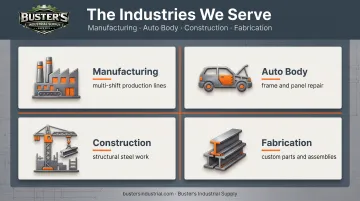
Welding equipment shows up across a wide range of industries:
- Manufacturing plants running multi-shift production lines
- Auto body shops repairing frames and panels daily
- Construction crews doing structural steel work on-site
- Metal fabrication shops building custom parts and assemblies
Buster's Industrial Supply works with industrial and fabrication shops in Texas, Wisconsin, Ohio, California, and other states. That multi-state reach means the team sees how brands hold up under daily shop use—not just showroom demos.
Here's how the top welder brands stack up for 2026.
Top Welder Brands to Buy in 2026
Rankings here are based on duty cycle performance, industry-recognized reliability, parts and service availability, and how well each brand covers MIG, TIG, and Stick applications.
Fronius
Fronius has built its reputation on precision inverter engineering for MIG, TIG, and Stick work. Buster's Industrial Supply is an authorized Fronius Perfect Welding dealer, so shops can source machines, consumables, and conversion kits with documented specs.
- The TransSteel 2200 is a 220-amp MIG/TIG/Stick multiprocess unit weighing about 34 pounds, running on both 120V and 240V input
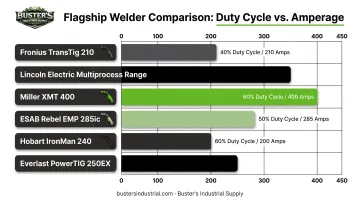
- The TransTig 210 delivers a 40% duty cycle at 210 amps, roughly four minutes of continuous welding, with an IP23 rating against rain, dirt, and debris
- The TransSteel 2700 is a professional-grade MIG machine built for industrial fabrication and manufacturing
| Best For | Fabrication shops needing precise multiprocess inverters |
| Key Technology | Inverter-based MIG/TIG/Stick machines with voltage-fluctuation compensation |
| Support | Strong OEM parts channels; authorized-dealer consumables and kits |
Lincoln Electric
Founded in 1895 in Cleveland, Ohio, Lincoln Electric has grown into one of the largest welding manufacturers in the world, with a product range that spans home shop machines to industrial-grade multiprocess systems.
Shops know Lincoln for stable arc characteristics and a deep product bench. The company operates 71 manufacturing and automation-integration locations across 20 countries, with distributors and sales offices in more than 160 countries—scale that usually means local dealer and service coverage.
| Best For | Auto body, professional fabrication, all skill levels |
| Key Technology | Wide amperage range, multi-process capability (MIG/TIG/Stick) |
| Support | Extensive authorized service network and strong warranty backing |
Miller Electric
Miller has been building arc welders since 1929, when founder Niels Miller started the company, and it remains a default choice in heavy manufacturing.
Newer units lean on inverter technology. The XMT 400, built for structural steel and heavy manufacturing, accepts single- or three-phase input from 208-600V without manual linking and delivers 400 amps at a 60% duty cycle—enough headroom for long beads without nuisance thermal cutouts.
| Best For | Heavy-duty industrial and manufacturing use |
| Key Technology | Advanced inverter-based multiprocess machines |
| Support | Strong dealer network and long-standing industrial trust |
ESAB
ESAB traces back to Swedish engineer Oscar Kjellberg, and it's since grown into a global operation with manufacturing plants across Europe, North America, South America, Asia/Pacific, and India, reaching 147 countries.
The Rebel EMP 285ic shows why professionals reach for ESAB when flexibility matters. It handles MIG, flux-cored, TIG, and Stick in one unit, running 5-350 amps on 3-phase power with a 285-amp rating at 50% duty cycle on that configuration.
| Best For | Professionals needing multi-process flexibility |
| Key Technology | Advanced digital control and multiprocess switching |
| Support | Global parts and consumables availability |
Hobart Welding Products
Hobart Brothers was incorporated in 1917, and the brand has carried a reputation for durable, no-nonsense machines ever since. It's a go-to for small shops and hobbyists who want something that just works.
The Handler 210MVP uses an industrial cast-aluminum wire-drive system for consistent feeding, while the IronMan 240 is built for demanding fabrication work at 200 amps and a 60% duty cycle. Setup is simple, and parts stay affordable.
| Best For | Small-scale shops, startups, and hobbyists |
| Key Technology | Reliable wire-feed systems, simple voltage controls |
| Support | Affordable parts and widely available accessories |
Everlast Welders
Everlast launched in 2004 in San Francisco as an online generator and welder retailer and built a following around efficient, portable inverters.
Its PowerTIG 250EX uses IGBT module construction for smooth, constant output, plus soft-switching that improves inverter reliability in a lightweight, lower-draw package.
| Best For | Shops prioritizing energy efficiency and portability |
| Key Technology | IGBT inverter design with step-less voltage/wire speed control |
| Support | Growing service footprint with competitive pricing |
How We Chose the Best Welder Brands
The most common mistake buyers make? Picking a brand based on price or "color loyalty" instead of matching duty cycle and power output to actual project demands. A machine that looks like a bargain can cost far more once it can't keep pace with your workload.
We ranked brands on the performance specs and support factors that show up on real jobs:
- Duty cycle and amperage range — Miller defines duty cycle as the share of a 10-minute period a machine can run before it must cool. At 30% and 215 amps, that’s three minutes of welding and seven minutes of cooling. Know this number before you buy.
- Inverter vs. transformer technology — Inverters run lighter and more portable, with finer control over arc variables than older transformer-rectifier designs.
- Warranty and service network strength — A strong machine with no local support becomes a liability the moment it goes down.
- Reputation among professional users — Brands that hold up for repeat commercial customers, not only one-time reviewers.
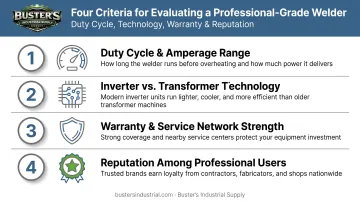
We also weighed what holds up when welders ship to contractors, fabricators, and shops day to day—not only what looks strong on a spec sheet.
Conclusion
There's no single "best" welder brand for every business. The right choice depends on your duty cycle needs, your budget, and the applications you run day to day, not which name is stamped on the case.
Before finalizing a purchase, evaluate how a machine performs over time, how easily you can source parts and consumables, and whether it can scale as your shop takes on bigger jobs.
A supply partner who knows the floor can make that decision easier. Buster's Industrial Supply works with fabrication and manufacturing shops from startup through growth. Jeff and the team help match welders and consumables to the work you actually run—so you buy for performance, parts access, and the next job, not the logo on the case.
Frequently Asked Questions
What are the best welder brands?
Lincoln Electric, Miller Electric, ESAB, Hobart, and Everlast are among the most established names in the industry. The "best" choice depends on your duty cycle needs, budget, and the applications you run most.
Which welder brand is best for beginners?
Hobart is well known for simple controls and durable, straightforward machines that suit new welders. Entry-level Lincoln and Miller models also offer strong support and forgiving learning curves.
Are expensive welder brands worth the investment for a small shop?
Higher-end brands pay off when you're welding frequently, thanks to better duty cycles and durability under repeated use. Occasional or hobby-level users often don't need that premium.
What is the most durable welder brand for industrial use?
Miller and Lincoln Electric both carry strong reputations for withstanding heavy manufacturing environments, with machines built for high duty cycles and continuous production runs.
What's the difference between MIG, TIG, and Stick welders when choosing a brand?
MIG feeds wire continuously for speed; TIG uses a non-consumable tungsten electrode for precise, clean welds; Stick uses self-shielded electrodes for outdoor and field work. Most top brands now offer multiprocess machines covering all three.
How do I choose a welder brand as my fabrication business grows?
Look for machines with scalable duty cycles that can handle increasing workloads without constant downtime. Working with a supplier like Buster's Industrial Supply, who understands growth-stage shops, makes it easier to upgrade equipment at the right time.