Picking the wrong blade, though, costs real money. A mismatched blade burns through segments early, slows down cuts, and can even glaze over mid-job. For contractors and fabrication shops working on tight margins, that mismatch adds up fast in wasted labor hours and replacement costs.
This guide breaks down blade types, ranks the top professional brands, and walks through the selection criteria that actually matter, so you can avoid buying the wrong blade twice.
Key Takeaways
- Diamond blades cut faster and last longer than abrasive wheels, especially on reinforced concrete
- Bond hardness must match material hardness — get this backward and the blade fails early
- MK Diamond, Husqvarna, Diablo, DeWalt, and Bosch each serve different budgets and job types
- Wet cutting controls silica dust and helps meet OSHA exposure limits on many jobs
- Match blade diameter, arbor, and RPM to your saw before you buy — mismatches waste money and cut quality
Overview of Diamond Concrete Cutting Blades in the Construction Industry
A diamond concrete blade is a steel core fitted with segments embedded with industrial diamond crystals, either brazed or laser-welded onto the rim. Instead of tearing through material like a toothed blade, the diamonds grind and abrade the concrete's surface. As the metal bond wears down, it exposes fresh diamond crystals underneath, keeping the cutting edge sharp throughout the blade's life.
That self-sharpening design is a big part of why diamond blades have become the default choice on commercial and industrial job sites. Contractors have steadily shifted away from bonded abrasive wheels toward diamond tooling because the performance gap is significant.
MK Diamond's own testing puts dry diamond blades at up to three times faster cutting and up to 100 times longer life than standard abrasive blades (a manufacturer figure, but one that lines up with why the switch has been so widespread).
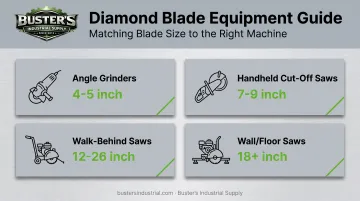
You'll find diamond blades running on four main types of equipment:
- Handheld angle grinders (4–5 inch blades)
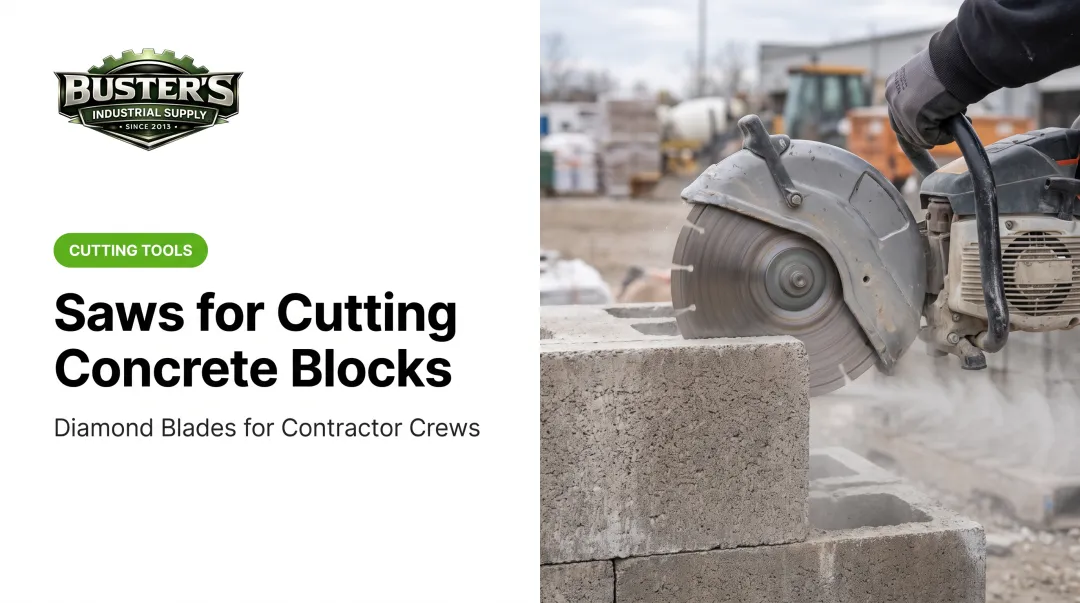
- Handheld cut-off saws (7–9 inch blades)
- Walk-behind saws (12–26 inch blades)
- Large wall saws and floor saws (18+ inch blades)
Buster's Industrial Supply stocks diamond blades from 5 to 26 inches, covering angle grinders, handheld cut-off saws, and walk-behind equipment. That range serves contractors and fabrication shops across Texas, California, Ohio, Wisconsin, Colorado, Louisiana, New Mexico, and Nevada.
Here's how the top professional brands compare.
Top 5 Diamond Concrete Cutting Blade Brands
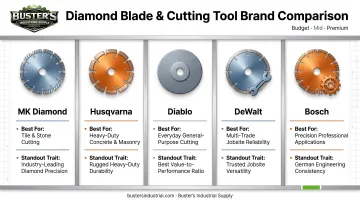
These five brands are ranked based on segment quality, bond technology, blade range, and reputation among professional contractors. There's no single "best" blade here — the right pick depends on your material and budget.
MK Diamond
MK Diamond has specialized in concrete cutting tools for decades and remains a go-to name among professional contractors who need dependable performance without a premium price tag.
What sets MK apart is breadth. Its lineup covers everything from light-duty masonry to heavy reinforced slabs, with strong segment retention that holds up on rebar-heavy cuts. For shops that need one supplier for multiple job types, that range is a real advantage.
| Attribute | Details |
|---|---|
| Best For | General to heavy-duty concrete and reinforced slabs |
| Blade Types Offered | Segmented, turbo, laser-welded |
| Standout Trait | Consistent performance across a wide range of concrete hardness levels |
Husqvarna
Husqvarna brings Swedish engineering credentials to the concrete cutting world and sits firmly in the premium tier of construction equipment brands.
Its VARI-CUT and ELITE-CUT lines use reinforced segment designs built for low-vibration cutting on long shifts with a walk-behind saw. Husqvarna blades are engineered to hold up on thick, heavily reinforced slabs where cheaper blades tend to glaze or wear unevenly.
For early-entry and green concrete work, Buster's Industrial Supply carries Husqvarna Soff-Cut blades in sizes from 6 to 13.5 inches.
| Attribute | Details |
|---|---|
| Best For | Heavy-duty and reinforced concrete cutting |
| Blade Types Offered | Segmented, Vari-Cut, Elite-Cut lines |
| Standout Trait | Premium build quality with extended segment life on hard aggregate |
Diablo
Diablo built its reputation on durable, budget-conscious segmented blades that show up on job sites and DIY projects alike.
The dry-cutting performance is the real selling point here. Diablo's segment design clears dust efficiently and holds an edge over repeated passes, which keeps cut quality consistent even after heavy use. It's a solid pick for crews cutting patios, pavers, and general masonry without a dedicated water source.
| Attribute | Details |
|---|---|
| Best For | Dry-cutting patios, pavers, and general masonry |
| Blade Types Offered | Segmented masonry blades |
| Standout Trait | Strong balance of longevity and affordability |
DeWalt
DeWalt's biggest advantage is availability. You can find its blades at nearly any supplier, backed by warranties that give contractors confidence in day-to-day use.
Its XP4 and XP7 lines use laser-welded segments built for reinforced concrete and hard brick, with continuous rim options available for cleaner edges on finish work. Plunge cuts stay stable, and compatibility with standard circular saws makes DeWalt an easy fit for crews already running DeWalt tools.
| Attribute | Details |
|---|---|
| Best For | General concrete, brick, and block cutting |
| Blade Types Offered | Continuous rim and segmented |
| Standout Trait | Reliable value with minimal edge chipping |
Bosch
Bosch is a premium European brand known for tightly controlled diamond segment design.
Its cooling slot design manages heat well under sustained load, which matters most on angle grinder applications where airflow is limited. Bosch blades stay stable during extended dry cuts across concrete, block, brick, and stone, and the brand claims up to five times the life of standard diamond blades on its Xtreme segmented rim line.
| Attribute | Details |
|---|---|
| Best For | Concrete, block, brick, and stone |
| Blade Types Offered | Segmented, professional diamond lines |
| Standout Trait | Reliable heat control during extended dry cuts |
How to Choose the Right Diamond Blade for Your Job
The most common buying mistake isn't picking the wrong brand — it's picking the wrong bond hardness. Get this backward and you'll either burn through a blade in days or watch it dull without cutting effectively.
By Material and Bond Hardness
Bond hardness works on an inverse rule:
- Hard, non-abrasive aggregate dulls diamonds quickly, so it needs a soft bond that wears away fast enough to expose fresh crystals
- Soft, abrasive material (like green concrete or sand-rich mixes) wears a soft bond too fast, so it needs a hard bond that resists premature erosion
Cured, reinforced concrete generally calls for a medium-to-hard bond. Green concrete and asphalt need something softer.
Once bond hardness matches the material, rim design is the next factor that shapes cut speed and edge quality.
By Blade Type
Three rim types dominate concrete work:
- Segmented — Cooling slots between segments dissipate heat and clear debris fast, making this the workhorse choice for most concrete cutting
- Turbo — A notched rim that runs more aggressively and smoothly than standard segmented blades, good for faster cuts in concrete, brick, and block
- Continuous rim — A solid diamond matrix that cuts slower but leaves the cleanest edge, better suited to tile and stone finish work than heavy concrete
Rim choice still has to work with how you cool the cut.
Wet vs. Dry Cutting
Water cools the blade, extends its usable life, and knocks down airborne dust significantly. Dry cutting trades some of that longevity and dust control for portability, useful for quick outdoor jobs without water access.
This isn't just a preference issue. OSHA's silica standard (29 CFR 1926.1153) requires integrated water delivery on handheld and walk-behind power saws, with respiratory protection required for indoor or enclosed use.
If your blade or saw setup can't support wet cutting where required, you're looking at a compliance problem, not just a performance one.
After bond, rim, and wet/dry method are set, the blade still has to fit the saw.
Blade Size and Equipment Compatibility
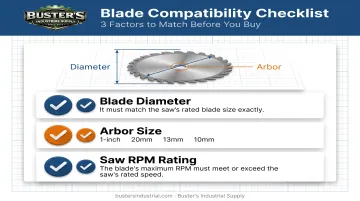
Blade diameter and arbor size have to match your saw exactly. Husqvarna's own selection guidance confirms that saw horsepower, allowed diameter, and required RPM all shift blade choice — a blade rated for a high-power saw can glaze on a weaker unit, while an undersized blade on a powerful saw wears out fast.
Common arbor sizes include 1-inch, 20mm, 13mm, and 10mm. Always check your saw's manual against the blade label before buying.
How We Chose the Best Diamond Blade Brands
We ranked brands on four practical factors contractors actually feel on the job:
- Segment quality — how well the diamond matrix holds up under sustained load
- Bond technology — whether the brand offers a genuine range of bond hardness options
- Field reputation — feedback from contractors using these blades daily, not just spec sheets
- Range and availability — how well a brand covers different concrete types and job sizes
Those criteria matter because the wrong match erases any price advantage. Buyers who shop on cost alone often skip bond hardness and blade type. A cheap hard-bond blade on hard aggregate can glaze over in a single job—costing more in downtime than the blade "savings."
Conclusion
The best diamond blade is the one matched to your specific material, saw, and cutting method. A premium blade running on the wrong bond hardness will underperform a budget blade that's properly matched to the job.
Before you buy, weigh blade lifespan and cutting efficiency against sticker price. A blade that costs more upfront but doubles your cuts per segment often pays for itself within a few jobs.
If you're not sure which blade fits your equipment and material, Buster's Industrial Supply's team, including Jeff and Buster, works directly with contractors and shops to match the blade to the job.
Frequently Asked Questions
What is the best blade for cutting concrete?
Segmented diamond blades are generally the best all-around choice for concrete. The cooling slots between segments clear debris and manage heat efficiently, keeping cutting speed consistent throughout the blade's life.
How long will a diamond blade last cutting concrete?
Lifespan depends heavily on bond hardness, how abrasive the material is, and whether you're cutting wet or dry. Wet cutting typically extends blade life noticeably by keeping the segments cooler.
Can a standard steel blade cut concrete?
No. Standard steel blades lack the diamond-embedded cutting surface needed to grind through concrete's hardness and abrasiveness, and they'll overheat or fail quickly if forced to try.
Is wet cutting better than dry cutting for concrete?
Wet cutting controls silica dust and heat buildup better, and it's required by OSHA in many handheld and walk-behind saw applications. Dry cutting trades some of that control for portability on jobs without water access.
How do I know what size diamond blade fits my saw?
Blade diameter and arbor size must match your saw's specifications exactly. Check your equipment manual or ask a supplier before buying to avoid an unsafe or inefficient mismatch.
Are cheaper diamond blades worth buying for occasional use?
For light, infrequent jobs, a budget blade can do the job fine. Professional crews running high-volume cuts should invest in premium segments, since the longer life and faster cutting typically offset the higher cost.