
Choosing the wrong cleaner doesn't just waste money. Untreated oil breaks down concrete's surface over time, creates slip hazards, and drags down curb appeal or resale value. The stakes are real: EPA identifies vehicle maintenance facilities as stormwater "hot spots" with elevated risk for oil, fuel, and grease spills that require dedicated cleanup protocols (EPA, 2023).
This guide ranks the five best concrete oil stain removers on the market, based on verified manufacturer data and real-world application details. Whether you're managing one driveway or a fleet yard with recurring spills, you'll find a product that fits.
Key Takeaways
- Enzyme, microbial, and poultice formulas outperform generic cleaners on oil trapped deep inside porous concrete.
- Fresh spills clear fastest with liquid degreasers; set-in stains need poultice or weeks-long bioremediation.
- PROSOCO's poultice and ACT's enzyme powder rank highest for chronic, deep-set commercial stains.
- Sealed vs. unsealed concrete decides whether acidic or solvent-based products are safe to use.
- Shops with recurring oil exposure should keep industrial-grade degreasers stocked for immediate spill response.
Overview of Concrete Oil Stain Removers in the Facility & Industrial Maintenance Market
Concrete oil stain removers are specialized formulas engineered to break down and lift petroleum-based hydrocarbons that have soaked into concrete's porous structure. That porosity is the whole problem. Concrete isn't a sealed surface. It's full of microscopic channels that pull oil downward the moment it hits the ground.
That's why a bucket of soapy water rarely works on anything but the freshest spill. Once oil penetrates below the surface, you need chemistry designed to reach it, not just wipe it away.
Three categories dominate the professional market:
- Enzyme and microbial treatments – living organisms or biological catalysts that consume hydrocarbon chains over time
- Poultice systems – absorbent pastes that pull embedded oil upward as they dry
- Degreasers and surfactant blends – fast-acting concentrates that lift fresh to moderate contamination on contact
Industrial businesses and auto shops typically don't buy these products one-off. They source degreasers, absorbents, and stain treatments through established supply partners who understand facility-scale needs.
Buster's Industrial Supply is one such partner, stocking professional-grade degreasers and stain treatments for ongoing facility maintenance.
Below, we rank the five products most commonly used across U.S. driveways, garages, and industrial floors.
Top 5 Best Concrete Oil Stain Removers
Each product below was evaluated on stain-lifting effectiveness, surface safety, application effort, and whether it fits DIY jobs, commercial facilities, or both.
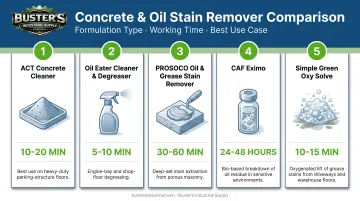
1. ACT Concrete Cleaner
ACT is a USDA BioPreferred certified dry powder that uses microbes and enzymes to bioremediate oil, grease, and antifreeze stains without scrubbing. You sprinkle the powder, brush it into the stain, and mist it until damp.
It breaks hydrocarbon molecules down at the molecular level instead of only lifting oil to the surface. The manufacturer's labeling describes the stain converting into water and oxygen as the microbes work. Results take longer than a liquid cleaner, but it's an eco-friendly option for stains other products can't touch.
| Attribute | Detail |
|---|---|
| Formulation Type | Dry enzyme/microbial powder |
| Working Time | Reapplication may be needed after 2 weeks; full results take several weeks |
| Best Use Case | Long-neglected oil stains on driveways, pavers, and garage floors |
2. Oil Eater Cleaner & Degreaser
Oil Eater is a water-based, biodegradable, low-VOC concentrate built for both household spot-cleaning and heavy industrial degreasing. For routine concrete cleaning, the manufacturer recommends a 10:1 water dilution with a five-minute soak before rinsing. For full-strength stains, it recommends saturating the area and letting it sit two to three hours.
The formula's advantage is scalability. One concentrate handles everything from a light driveway spot to a heavily soiled shop floor, and it's approved for use around food-service-adjacent surfaces.
| Attribute | Detail |
|---|---|
| Formulation Type | Water-based degreaser concentrate |
| Working Time | 5 minutes (routine) to 2-3 hours (concentrated soak) |
| Best Use Case | Routine and fresh oil/grease stains on shop floors, driveways, and equipment |
3. PROSOCO Oil & Grease Stain Remover
PROSOCO is a ready-to-use poultice paste containing surfactants, solvents, and powders. You pour it directly over the stain, extending at least an inch beyond the visible boundary, then let it dry for 5-8 hours (or overnight) before sweeping up and rinsing.
Unlike liquid cleaners that can push oil deeper during scrubbing, the poultice draws hydrocarbons upward as it dries. That mechanism makes it one of the few products documented to work on long-set commercial stains in a single application, though the manufacturer notes reapplication is fine if a stain resurfaces.
| Attribute | Detail |
|---|---|
| Formulation Type | Poultice paste |
| Working Time | Applied and left to dry 5-8 hours or overnight |
| Best Use Case | Deep-set, chronic oil stains in commercial and industrial facilities |
4. CAF Outdoor Cleaning Eximo Waterless Concrete Cleaner
Eximo is a microbe-based, waterless dry treatment that breaks hydrocarbon chains in gasoline, diesel, and oil stains. You apply roughly a quarter cup per 55 square feet and sweep it across the surface in multiple directions. No rinsing, no scrubbing.
The living microbes keep working below the surface after application, which is why the manufacturer recommends weekly reapplication over four to six weeks for full results. That patience pays off on parking lots and paver surfaces where pressure washing isn't practical.
| Attribute | Detail |
|---|---|
| Formulation Type | Dry microbial treatment |
| Working Time | 2-3 weeks for reduction; 4-6 weeks for full treatment |
| Best Use Case | Petroleum stains on parking lots, sidewalks, and paver surfaces |
5. Simple Green Oxy Solve Total Outdoor Cleaner
Simple Green Oxy Solve is a peroxide-based liquid concentrate recognized by the EPA's Safer Choice Program. It works with either a pressure washer or a spray bottle. The pressure-washer method calls for a low-pressure application, a 3-5 minute dwell, and a high-pressure rinse held at least two feet from the surface.
Treat it as a fast-acting pretreatment rather than a deep-stain solution. Pair it with an absorbent like cat litter on a fresh spill, and it performs well. It's also safe across multiple outdoor surface types, which makes it a flexible pick for general cleaning with occasional oil spot duty.
| Attribute | Detail |
|---|---|
| Formulation Type | Peroxide-based liquid concentrate |
| Working Time | 3-5 minutes before rinsing or pressure washing |
| Best Use Case | General driveway and patio cleaning with occasional oil spot treatment |
How We Chose the Best Concrete Oil Stain Removers
The biggest mistake buyers make is grabbing a generic all-purpose cleaner for a stain that's already soaked deep into the concrete. The second biggest: applying an acidic or solvent-based product without checking whether the surface is sealed.
According to the Concrete Masonry & Hardscapes Association, even weak acids can dissolve the cement matrix, increase porosity, and permanently alter the surface's color and texture.
We weighed four factors for every product:
- Stain-lifting chemistry – enzyme, microbial, poultice, or surfactant-based, matched to how deep the oil has penetrated
- Surface safety and certifications – whether the formula is documented safe for sealed, polished, or unsealed concrete
- Working time versus effort – minutes for a degreaser versus weeks for a biological treatment, weighed against labor involved
- Versatility – whether the product scales from a single bay or stall to an industrial floor plan
Those criteria map to real shop outcomes. Faster remediation means less facility downtime. Biodegradable, EPA-recognized formulas also cut liability and cleanup costs for commercial sites that deal with recurring spills, not one-off messes.
Conclusion
There's no single "best" concrete oil stain remover. The right choice depends on how old the stain is, whether your concrete is sealed, and how fast you need results.
A fresh spill in a shop bay calls for a degreaser you can apply and rinse the same day. A years-old stain in a fleet yard corner probably needs a poultice or weeks of microbial treatment. For facilities with recurring oil exposure, cost-per-application and scalability matter more than brand recognition.
Match the method to the stain, then stock what your shop actually uses. Industrial businesses sourcing degreasers, absorbents, and cleaning supplies can work with Buster's Industrial Supply for product selection and ongoing restocking support.
Frequently Asked Questions
What removes oil and grease from concrete?
Enzyme, microbial, and poultice-based removers work best, especially paired with an absorbent like cat litter for fresh spills. Degreasers handle lighter, more recent stains without needing weeks to work.
What is the best concrete cleaner for removing oil stains?
For deep, set-in stains, enzyme-based cleaners like ACT and poultice products like PROSOCO's Oil & Grease Stain Remover perform best. Both target oil trapped below the surface rather than just the visible mark.
Do degreasers remove oil stains from concrete?
Yes, degreasers like Oil Eater effectively break down fresh to moderate oil stains. Older, deeply penetrated stains typically need repeated applications or a different approach entirely.
How do professionals remove oil stains from concrete?
Professionals usually combine absorbents, industrial-strength degreasers, or poultice treatments, sometimes finishing with pressure washing. Most source these products through industrial supply partners to keep results consistent across jobs.
How long does it take for an oil stain remover to work on concrete?
Liquid degreasers can work in as little as 5 minutes. Enzyme or microbial treatments take several weeks to fully break down a stain, since they work below the surface.
Can old, set-in oil stains be removed from concrete?
Yes, but rarely in one pass. Older stains typically require poultice or enzyme-based treatments with multiple applications rather than a single surface cleaner.