Introduction
A mechanic leans on a breaker bar, and instead of the bolt turning, it snaps flush with the frame. Sound familiar? Rusted fasteners seize because corrosion fills the microscopic gap between threads, welding metal to metal.
Reaching for a torch or muscling through with brute force often makes things worse, cracking castings or rounding off bolt heads that are already hard to reach.
Penetrating oil is the smarter first move, but formulas vary widely in how fast they work and how much corrosion they can break down. This guide covers how penetrating oil works, five top picks for rusted bolts, the right application technique, and how to match the product to the job.
TL;DR
- Low-viscosity oil uses capillary action to seep into corroded threads and break the rust bond
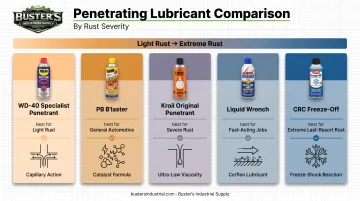
- Match rust severity with WD-40 Specialist Penetrant, PB B'laster, Kroil, Liquid Wrench, or CRC Freeze-Off
- Soak time and reapplication matter more than brand name on stubborn corrosion
- Buster's Industrial Supply stocks penetrating lubricants so shops and facilities can keep the right product on hand
Overview of Penetrating Oil in US Industrial Maintenance
Penetrating oil is a low-viscosity oil and solvent blend engineered to free seized or corroded metal fasteners. That's different from a general-purpose lubricant, which reduces friction on parts that already move freely.
Mechanics, fabricators, fleet techs, and construction crews keep it within reach. A seized bolt on a production line or fleet vehicle doesn't just cost time; it costs real money.
Automotive manufacturers reported losing $2.3 million for every hour of unplanned downtime in 2024, roughly double the 2019 figure, according to Siemens' industry analysis. A seized fastener holding up a repair or line changeover is exactly the kind of delay that adds up fast.
The products below were selected for field performance, not marketing copy:
- Penetration speed
- Corrosion-breaking power
- Consistent results in the shop
Shops across Texas, Ohio, California, and other states rely on having a dependable penetrant on the shelf before they need it, not after a bolt has already snapped.
Top 5 Penetrating Oils for Rusty Bolts
Each of these five products earned its spot based on capillary penetration speed, how well it breaks rust bonds, retail availability, and a track record with mechanics and MRO professionals.
1. WD-40 Specialist Penetrant
WD-40 Specialist Penetrant is a dedicated rust-fighting formula, separate from the original multi-use WD-40, and it's built specifically to free seized fasteners rather than just displace moisture.
Its EZ-Reach applicator features an 8-inch flexible straw that holds its shape, letting you direct the spray into tight, awkward spots without repositioning the whole can. It's also one of the easiest penetrants to find at any hardware counter.
| Attribute | Details |
|---|---|
| Best For | Light to moderate rust, everyday maintenance tasks |
| Key Mechanism | Solvent-based capillary action with a light lubricating residue |
| Application Format | Aerosol with flexible straw applicator |
2. PB B'laster
In production since 1957, PB B'laster has become one of the most recognized penetrants in North American shops and garages. It's the can a lot of mechanics grab first simply because it's everywhere.
Its ProStraw applicator with Control Flow Technology improves accuracy on small or recessed fasteners, and the formula leaves a non-evaporating lubricant behind for added corrosion protection after the bolt breaks loose.
| Attribute | Details |
|---|---|
| Best For | Automotive repair, general maintenance, field jobs |
| Key Mechanism | Penetrating catalyst formula with lasting lubricating residue |
| Application Format | Aerosol can with ProStraw precision applicator |
3. Kroil Original Penetrant
Kano Laboratories has manufactured Kroil since 1939. Aviation crews, heavy-industry techs, and MRO teams reach for it when other penetrants can't free a fastener.
Its ultra-low viscosity is the whole point: the thinner the oil, the further it can travel into a corroded thread gap before the rust bond wins out. That's why it shows up in industrial toolboxes as much as automotive ones.
| Attribute | Details |
|---|---|
| Best For | Severe rust, specialty fasteners, industrial equipment |
| Key Mechanism | Ultra-low viscosity formula built for maximum capillary penetration |
| Application Format | Aerosol spray, liquid can, or drip bottle |
4. Liquid Wrench Penetrating Oil
Liquid Wrench has been a retail staple since 1941, and shops keep it on hand when they need something fast-acting without ordering from a specialty supplier.
The formula is built to penetrate corrosion and loosen rusted bolts quickly, and it includes a Cerflon solid lubricant that keeps working after the initial soak, cutting friction as the fastener starts to move.
| Attribute | Details |
|---|---|
| Best For | General automotive, shop maintenance, light industrial use |
| Key Mechanism | Fast-seeping formula with Cerflon lubricant for reduced friction |
| Application Format | Aerosol can with precision straw |
5. CRC Freeze-Off Super Penetrant
CRC Freeze-Off takes a different approach entirely. Instead of relying purely on capillary flow, it uses a Freeze Shock reaction that rapidly chills the metal on contact, cracking the rust layer so oil can follow behind it into deeper corrosion.
Use it as an escalation product when standard penetrants have already failed on a badly seized nut, bolt, or joint. It's also an extremely flammable aerosol, so ventilation and distance from any heat source are non-negotiable.
| Attribute | Details |
|---|---|
| Best For | Extreme rust, last-resort situations, stubborn automotive fasteners |
| Key Mechanism | Freeze-shock action that cracks rust layers to speed penetration |
| Application Format | Aerosol spray can |
How Penetrating Oil Works — and How to Apply It the Right Way
Penetrating oils combine solvents, rust-reacting agents, and lubricants that flow into microscopic gaps between corroded threads through capillary action. The lower the viscosity and the better the surface tension balance, the deeper and faster the oil travels, a relationship first described by the Lucas-Washburn capillary flow principle back in 1921.
According to WD-40's own explanation of the mechanism, solvents and reactants in the formula attack the rust bond while the oil base reduces friction once the fastener starts to move. Penetrating oil doesn't dissolve rust. It weakens the corrosion bond and lubricates the surface so the fastener can turn.
Applying It Correctly
- Clean off surface debris — dirt and grime block the oil from reaching the threads
- Saturate the bolt generously — let excess oil work around the head and into the joint
- Let it soak — several minutes for light rust; hours or overnight for severe corrosion
- Attempt to loosen — use the correct wrench or socket size, not an oversized tool that can round the head
- Reapply if it doesn't budge — repeated applications over time often outperform a single heavy dose
The most common mistake? Rushing the soak time and forcing the fastener too soon. That's how bolts snap and heads round off, turning a five-minute job into a drilling-and-extraction project.
Never spray penetrating oil near an open flame or right after torch-heating a fastener. Most formulas are flammable, and heat causes the oil to evaporate before it has a chance to work.
How We Chose the Best Penetrating Oils
We evaluated these products on documented penetration mechanism, corrosion-breaking performance, safety profile, and real-world use across automotive and industrial settings, not brand recognition or marketing claims.
When you're buying your own, weigh these factors:
- Viscosity and capillary performance — thinner oils generally reach deeper into tight thread gaps
- Soak time versus residue protection — some formulas work fast but leave little lasting lubrication, others do both
- Corrosion inhibitors like PTFE, which extend protection after the fastener frees up
- Application format — aerosol cans handle quick jobs, while bulk liquid or drum formats suit high-volume shop use
A common buying mistake is grabbing whatever's familiar or cheapest, regardless of how severe the rust actually is. A light aerosol penetrant won't touch a fastener that's been seized for a decade outdoors.
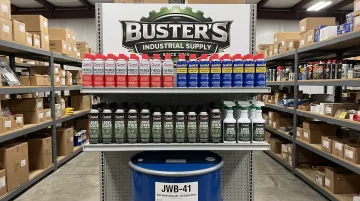
Match the formula to the job. At Buster's Industrial Supply, that span runs from Quest PIERCE and ZenaTuff aerosols for routine shop work to JWB-41 in 55-gallon drums for high-volume fleet and facility use. PTFE options like Quest Loose Screw cover fasteners that need both penetration and lasting corrosion protection.
Conclusion
There's no single "best" penetrating oil, because the right choice depends on how bad the corrosion is and what the job demands. A fast everyday penetrant handles routine maintenance, while a severe-rust specialist or freeze-shock product earns its place for the fasteners that fight back.
Smart shops keep both types on the shelf rather than betting everything on one can. Buster's Industrial Supply stocks penetrating oils, PTFE-based lubricants, and anti-seize compounds for reinstallation. That mix helps shops across Texas, Ohio, California, and other service areas stay ready for routine maintenance and the emergency call that can't wait.
Frequently Asked Questions
Can penetrating oil remove rust from bolts?
No. Penetrating oil doesn't dissolve rust; it weakens the corrosion bond through capillary action and lubrication, which lets the fastener turn. Any loose rust flakes off mechanically once you start working the bolt.
What do mechanics use to loosen rusted bolts?
Most mechanics reach for a dedicated penetrant, along with proper soak time and the correct hand tools rather than force alone. Reapplying the oil and letting it sit longer usually beats swapping brands.
What is the best penetrating oil or anti-seize to use on exhaust manifold bolts?
A heat-tolerant penetrant works best for removal on manifold bolts, since they see repeated thermal cycling. On reinstallation, apply a copper-based anti-seize compound instead, which prevents the same seizing from happening again.
How long should you let penetrating oil sit before trying to loosen a bolt?
Several minutes is a reasonable starting point for light rust, but severely seized fasteners can need hours or overnight soaking with reapplication in between. There's no universal timer here; more time generally helps.
Is WD-40 the same thing as penetrating oil?
Not quite. Standard WD-40 is a moisture displacer and light lubricant, while WD-40 Specialist Penetrant is a distinct formula built specifically to break rust bonds on seized fasteners.
Can you use heat together with penetrating oil?
Not at the same time. Heat and penetrant should be used in alternating steps, since most penetrants are flammable and heat causes them to evaporate before they can soak in. Heat first, let it cool, then apply the oil.