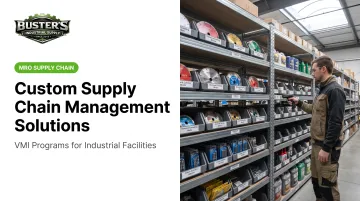
The financial stakes are real. McKinsey found that a supply chain disruption lasting 30 days or fewer can put 3% to 5% of EBITDA margin at stake — and over a decade, companies can lose as much as 45% of a full year's EBITDA to disruptions like these.
Generic, catalog-only distributors don't help the situation. Inconsistent stock. Slow callbacks. No one who actually knows your shop's setup. You end up managing the supplier instead of your production line.
This guide breaks down what custom supply chain management solutions actually look like, the core pieces that make them work, and how to pick a partner who treats your business like more than an account number. We'll use Buster's Industrial Supply's relationship-driven approach as a working example throughout.
Key Takeaways
- Custom supply solutions combine inventory, procurement, and account support around your actual workflow
- Disconnected vendor relationships drain time, budget, and production uptime
- VMI, kitting, and JIT/emergency fulfillment are the core building blocks of a tailored program
- A dedicated account rep cuts resolution time and builds long-term accountability
- Consolidating with one partner simplifies admin without sacrificing pricing
What Is a Custom Supply Chain Management Solution?
A custom supply chain solution is a tailored mix of inventory management, procurement, and delivery services built around your specific workflows, consumption patterns, and growth stage. It goes well beyond a standard ordering account with a discount code attached.
Custom vs. Off-the-Shelf Distributor Relationships
With a typical catalog distributor, you adapt to them: their stock levels, their pricing tiers, their delivery windows. A custom solution flips that arrangement. The supply partner builds programs around what you actually consume and when you need it, instead of forcing your operation into their standard order form.
Who benefits most:
- Manufacturing and fabrication shops with specialized material needs
- Multi-location operations trying to keep pricing and service consistent across sites
- Growing businesses whose material needs shift from quarter to quarter
A custom solution isn't one tool. It's usually several service layers working together: inventory programs, dedicated account support, and, where a partner offers it, consolidated vendor relationships that reduce how many suppliers you're managing at once.
That fragmentation problem is bigger than most businesses realize. McKinsey's research on MRO procurement found that supply operations typically run through a "sprawling, fragmented network of vendors" covering tools, safety gear, and maintenance items. That structural mess drains both budget and staff time.
Why Generic, One-Size-Fits-All Supply Arrangements Fail Growing Businesses
Juggling five or six vendors to cover your full parts list sounds efficient until you actually need something fast. Each one has its own lead times, its own pricing structure, and its own call center that doesn't know your account history.
Common failure points:
- Inconsistent lead times across vendors, forcing you to overbuy "just in case"
- Fragmented pricing that turns budgeting into guesswork
- No single point of contact when an urgent need hits
- Duplicate ordering for overlapping product categories
That overbuying habit carries a real cost. Cash gets tied up in shelves of parts you may never use, and stockouts still happen anyway, right when a critical item runs out mid-shift.
A missing part costs more than its sticker price. You pay in stalled production, missed customer deadlines, and overtime spent catching up. A responsive supply partner who already knows your operation can turn a potential shutdown into a same-day fix instead of a multi-day scramble.
Core Components of a Tailored Industrial Supply Chain Solution
A true custom supply chain solution stacks several coordinated components, not just a lower price per unit. Here's what those pieces typically look like in practice.
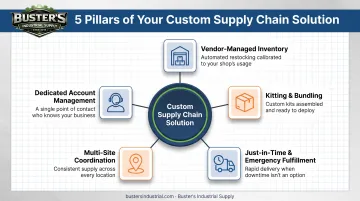
Vendor-Managed Inventory (VMI) and Stock Programs
VMI programs let your supply partner monitor on-site stock and automatically replenish it before critical parts run out. Buster's runs this model for qualified accounts spending $500 or more per month, at no added cost.
Reps handle the full loop:
- Visit the shop and organize the supply room
- Restock MRO, welding, and industrial essentials
- Send monthly usage reports
Restocking schedules flex to match how fast each item actually moves, rather than a fixed calendar.
Kitting, Bundling, and Job-Ready Supply Packages
Pre-kitted supply packages built for a specific machine, project, or production run save labor time on the floor and cut down on ordering mistakes. Instead of a tech hunting for six separate SKUs before a job starts, everything needed arrives as one bundle.
For example, welding equipment sold with a matched accessory package (gun, feeder rolls for different wire types, grounding cable, flow meter) arrives ready to run. For recurring jobs, ask a prospective partner whether they'll build something similar around your specific equipment list.
Just-in-Time and Emergency Fulfillment
Scheduled JIT delivery keeps routine consumables flowing without tying up cash in excess stock. But JIT only works if there's a real emergency option behind it for the day something runs out anyway.
Buster's ships same-day orders placed before 2 PM CT, offers expedited two-day or overnight shipping at checkout, and takes rush-order calls directly for anything that can't wait. Standard ground delivery runs 2 to 5 business days.
The point of an emergency channel isn't the average. It's what happens the one day a bad shipment or a blown blade threatens to shut your line down.
Multi-Location and Multi-Site Coordination
Businesses running multiple shops or operating across state lines need consistent pricing and a single ordering relationship, not five separate regional accounts. Buster's supports this through direct rep involvement: one customer, Cooper Hukill, has Jeff stocking and refilling both of his own shops plus numerous partner shops, keeping supply consistent everywhere without separate negotiations at each site.
Dedicated Account Management
A named point of contact who knows your operation replaces the call-center lottery. Jeff, Buster's Team Lead and Sales Representative, personally visits customer shops to restock supplies and troubleshoot in person, whether it's a brand-new startup setting up its first inventory system or a shop he's serviced for years.
That continuity means problems get solved by someone who already knows your setup.
Key Benefits of Partnering with a Custom Supply Chain Provider
Bring these components together under one partner and the payoff shows up in a few concrete places.
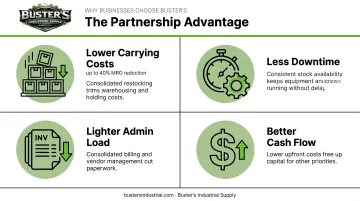
- Lower carrying costs. Tailored replenishment targets what you actually use. McKinsey documented a materials company that cut MRO inventory levels by 40% after clearing obsolete stock and employee "squirrel stores."
- Less downtime. Reliable emergency and JIT fulfillment turns a shortage into a same-day phone call instead of a stalled production line.
- Lighter admin load. Fewer vendors means fewer invoices, fewer purchase orders to track, and one relationship instead of five.
- Better cash flow. Demand-based ordering keeps cash out of bulk stock you may never use. Buster's blanket purchase agreements can lock pricing for six or 12 months against mid-year hikes.
Service quality often decides whether a supplier relationship lasts. McKinsey's 2024 B2B Pulse survey of nearly 4,000 B2B decision-makers found that 65% would switch suppliers after a service "hiccup," and over half would leave without easy access to the right person.
A dedicated rep who already knows your account is often the difference between a hiccup and a lost customer.
How Buster's Industrial Supply Delivers Custom Supply Chain Solutions
Buster's Industrial Supply is a one-stop industrial supply partner for manufacturing, fabrication, and industrial businesses across Texas, Wisconsin, Ohio, California, Colorado, Louisiana, New Mexico, and Nevada. The company builds tailored inventory programs, competitive pricing, and hands-on service around how each shop actually runs.
Founded in 2015 by Jeff Buster after decades working inside larger industrial suppliers, the company was built to compete on service and consultation, not just the lowest sticker price. That decade-plus track record now spans:
- Construction and concrete cutting
- Manufacturing and fabrication
- Fleet and automotive maintenance
- Facilities and janitorial operations
Jeff, Buster's Team Lead and Sales Representative, is the face of that promise for many customers. He personally visits shops to restock supplies, organize storage rooms, and troubleshoot on the spot, whether it's a startup setting up its first ordering system or a shop that's been a customer for over a decade.
Long-term accounts show how that model sticks. Cooper Hukill has Jeff stocking both of his own shops plus numerous partner locations. James "O'Dell" Nolan has known Buster for more than 10 years across multiple shops.
For accounts spending $500 or more a month, that relationship includes:
- Free on-site stocking
- Inventory organization
- Monthly usage reports
That VMI backbone described earlier is delivered by a rep who already knows the shop floor.
That reliability shows up in the numbers customers actually see: a 4.9-star average rating, most orders shipping within 1 to 2 business days, and a GSA MAS contract (47QSMS25D007Y) that qualifies Buster's for federal and institutional procurement.
How to Choose the Right Supply Chain Partner for Your Business
Not every supplier is built to run a custom program. Before signing on, run prospective partners through a short checklist.
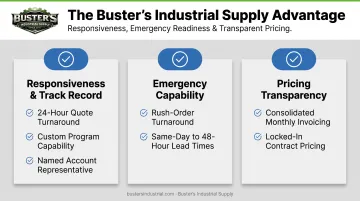
Evaluate responsiveness and track record:
- Do they answer calls and quotes within a business day, not a week?
- Will they build a custom inventory or procurement program, or just sell off a catalog?
- Can they point to customers of a similar size or vertical to yours?
- Do they offer a named contact instead of a rotating call center?
Probe emergency capability: Ask for specifics. What's the turnaround on an urgent order? What are typical lead times for the parts you use most? A supplier who can't answer clearly probably hasn't had to prove it yet.
Check pricing transparency: Look past today's discount. A partner worth keeping should show where consolidating vendors actually saves money: fewer invoices, predictable pricing, and one point of accountability. That beats undercutting a competitor's quote just to win the first order.
Buster's Industrial Supply, for instance, offers blanket purchase agreements that lock pricing for six or 12 months. Locked-in terms protect your budget across the full agreement, not only the first PO.
Frequently Asked Questions
What is JDA software used for?
JDA Software, now called Blue Yonder, is enterprise supply chain planning software used for demand forecasting, inventory optimization, and logistics management. It works best paired with a reliable physical supply partner who can actually execute what the software plans.
What are the 5 pillars of supply chain management?
The five classic pillars are planning, sourcing/procurement, manufacturing, delivery/logistics, and returns (often shortened to Plan, Source, Make, Deliver, Return). Modern frameworks add orchestration and enablement, but these five still describe the core flow.
What exactly is a custom supply chain solution?
It's a tailored combination of inventory, procurement, and delivery services built around your specific workflows, consumption patterns, and growth stage , not a standard catalog account with a discount attached.
How does vendor-managed inventory (VMI) work with an industrial supply partner?
Your supply partner monitors on-site stock levels and automatically replenishes critical items before you run out, often including on-site organization and usage reporting. Buster's offers this free for qualified accounts spending $500 or more per month.
Why should I consolidate suppliers with a single industrial supply partner?
Fewer vendors means fewer invoices, more consistent pricing, and one point of accountability when something goes wrong. It also frees up staff time otherwise spent managing multiple vendor relationships.
How quickly can Buster's Industrial Supply fulfill an emergency order?
Orders placed before 2 PM CT typically ship the same day, with expedited two-day and overnight options available at checkout. For true rush needs, call Buster's directly to coordinate the fastest path to your shop.