Contractors run into this constantly: grab a blade off the truck, assume it'll work because it "cuts through concrete fine," and end up with a glazed, overheated disc halfway through the job. The result is wasted labor hours, a ruined blade, and sometimes a dangerous kickback situation.
This guide breaks down the blade types built for asphalt, how to pick the right one for your saw and jobsite, proper cutting technique, and where to source blades that actually hold up. Buster's Industrial Supply stocks asphalt-specific diamond blades and has staff, including longtime team lead Jeff, who help contractors match specs to their equipment before they buy.
Key Takeaways
- Asphalt's abrasive aggregate demands a softer-bonded diamond blade, not a standard concrete blade
- Segmented rims are the go-to choice for most asphalt jobs; continuous and turbo rims serve narrower use cases
- Blade diameter must match your saw type: handheld cutters typically run 12-14 inches, walk-behinds go larger
- Wet cutting controls dust and heat better; dry cutting trades some blade life for mobility
- Replace a blade once segments wear below roughly 50% of original height
Why Diamond Blades Are Essential for Cutting Asphalt
Asphalt pavement is roughly 95% aggregate (stone, sand, and gravel) and 5% asphalt binder, according to the National Asphalt Pavement Association.
The binder holds everything together and gives the mix flexibility. The aggregate is what destroys a poorly matched blade.
That combination makes asphalt paradoxical: soft enough to cut quickly, abrasive enough to strip a blade's cutting edge in short order.
How Diamond Blades Actually Cut
A diamond blade doesn't slice like a saw tooth. It grinds. Exposed diamond crystals embedded in the segment wear the material into fine powder. As those diamonds dull, the surrounding metal bond erodes just enough to expose fresh cutting points underneath.
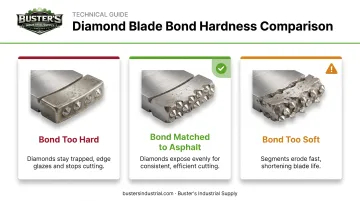
That self-sharpening cycle is why bond selection matters:
- Bond too hard → it won't erode fast enough, diamonds stay buried, and the blade glazes over (loses its bite)
- Bond too soft → the matrix wears away too quickly, and you burn through diamond segments prematurely
- Bond matched to asphalt → controlled erosion keeps sharp diamond exposed the whole job
Manufacturers generally build asphalt blades with a bond suited to soft, abrasive material — noticeably different from the harder bonds used in concrete blades designed for compressive strength and rebar. Using the wrong one doesn't just slow you down; it means buying replacement blades far more often than necessary.
Matched diamond blades also cut cleaner than standard steel or abrasive wheels, with less flying debris. A properly matched blade is far less likely to bind mid-cut, one of the more common kickback triggers on a jobsite.
Types of Diamond Blades for Asphalt Cutting
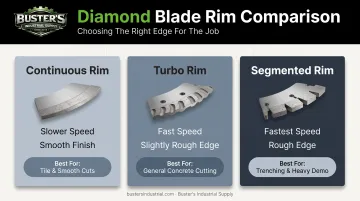
Rim design drives almost everything about how a blade performs: cut speed, edge quality, heat dissipation, and where it's best suited. For asphalt, three rim styles come up most often.
| Rim Type | Cut Quality | Speed | Best For |
|---|---|---|---|
| Continuous | Smooth, chip-free | Slower | Finished edges, precision work |
| Turbo | Slightly rough | Fast | Larger jobs prioritizing speed |
| Segmented | Rough | Fast, high clearance | Trenching, demolition prep |
Continuous Rim Diamond Blades
The unbroken edge on a continuous rim produces the smoothest, chip-free cut of the three options. If you need a clean finished edge, this is the design to reach for. It's almost always used with wet cutting since the continuous rim needs steady water flow to stay cool and to flush debris.
Turbo Rim Diamond Blades
Turbo blades use a serrated, wave-like segment pattern that lets them bite faster than a continuous rim. The trade-off is a rougher edge. For larger asphalt jobs where production speed matters more than a polished look, turbo blades close out the day faster.
Segmented Diamond Blades
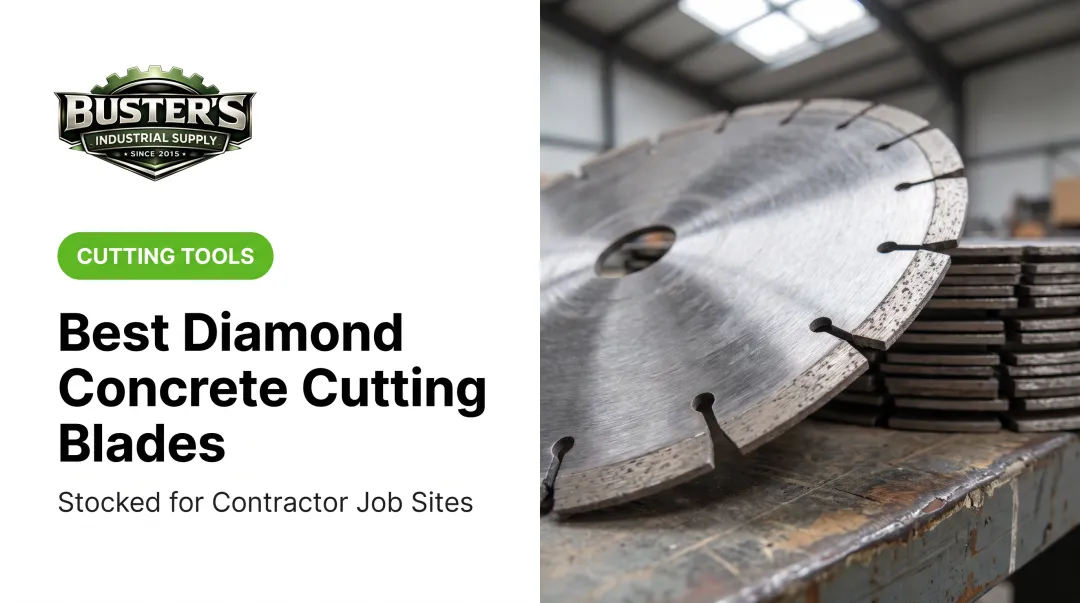
Segmented blades have wide, deep gullets cut between each segment. Those gaps do two jobs at once: they clear debris and they let air and water circulate to pull heat away from the blade. This makes segmented blades the standard choice for heavy-duty, high-volume asphalt work like trenching, utility cuts, and demolition prep.
When you're matching rim style to the job, having the right sizes on hand matters as much as the design. Buster's stocks options built for asphalt work, including:
- 12" x .125" Turbo Seg Combo Blade and 14" x .125" Turbo Supreme Combo Blade (asphalt and concrete)
- Dedicated segmented asphalt blades in 14-, 18-, and 20-inch diameters
How to Choose the Right Asphalt Blade for Your Project
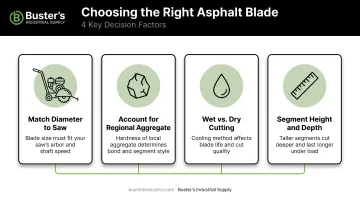
Picking a blade isn't guesswork once you know what to check. Four factors matter most.
Match Diameter to Your Saw
Compact cut-off tools often take 7-9 inch blades. Full-size handheld power cutters typically run 12-14 inch blades with a maximum cut depth of 4-5 inches, based on Husqvarna's current handheld saw catalog. Walk-behind saws scale up considerably, with some larger floor saws cutting close to 10 inches deep. Buster's stocks options across that range:
- 7-9 inch blades for handheld cut-off saws
- 12-16 inch blades for standard walk-behind saws
- 18-26 inch blades for larger walk-behind and diesel-powered saws
Always double-check arbor size too. Most run 20mm or 1-inch, and mismatching this stops the job before it starts.
Account for Regional Aggregate
Aggregate hardness varies a lot by region: softer limestone in some areas, harder quartz or chert-based rock in others. Harder local aggregate wears blades faster and calls for a more abrasion-resistant bond. A blanket "best blade" pick doesn't exist; it depends on what's underfoot on your specific job.
Wet vs. Dry Cutting
Wet cutting cools the blade continuously and controls dust. It is also the compliance route OSHA's silica standard requires for many handheld and walk-behind saws, which call for integrated, continuous water delivery to the blade.
Dry cutting offers more mobility when you lack a water source, but it needs a dry-rated blade and periodic cooling pauses.
Segment Height and Depth
Deeper cuts and higher daily volume generally call for taller segments. Buster's Pro Asphalt lines range from 10mm segments (lighter-duty) up to 15mm (heavy-duty), giving contractors options based on how hard the blade will be worked.
Not sure what fits your saw? Jeff and the team at Buster's Industrial Supply help both new and established contractors match blade specs to their equipment and workload. Call 817-367-9101 for a recommendation; most orders ship within 1-2 business days.
Step-by-Step Guide to Cutting Asphalt with a Diamond Blade
Good technique protects the blade and the operator. Here's the sequence that works on most asphalt jobs:
- Mark the cutting line with chalk for straight cuts, or a template for curves. A clear line keeps the first pass accurate.
- Choose wet or dry cutting based on site conditions: wet if you have water access and want cleaner cuts, dry if mobility matters more.
- Make a shallow guide pass, roughly 1-2 inches deep, to establish the kerf before cutting to full depth.
- Cut to full depth in successive passes, keeping steady, even feed pressure. Never force the blade.
Essential Safety Steps
- Wear eye protection, gloves, and hearing protection at minimum.
- Add a respirator for dry cutting since airborne silica dust is a real hazard.
- Keep firm footing and both hands on the saw.
- Run the blade at full operating speed before it contacts the asphalt to reduce kickback risk.
Diamond Blades vs. Concrete Blades: What's the Difference?
The core difference comes down to bond hardness. Concrete blades are engineered with a harder bond because concrete's compressive strength (and often embedded rebar) demands it. Asphalt blades use a bond suited to asphalt's softer, more abrasive makeup.
Can you use a concrete blade on asphalt? Technically, yes, in a pinch. But it's not a good long-term plan:
- Concrete blades wear noticeably faster on asphalt's abrasive aggregate
- Cutting efficiency drops since the bond isn't matched to the material
- You'll likely spend more replacing blades than you saved skipping the right one
For jobs that cut through asphalt and the concrete or curb underneath, a combo blade solves the mismatch. Buster's stocks dual-purpose options for this, including a 16" x .140 Pro Green Concrete Asphalt blade rated for wet cutting both materials.
That setup fits utility cuts and curb work where the material changes mid-cut.
Common Mistakes and Blade Maintenance Tips
Most premature blade failures trace back to one of a few habits.
- Forcing the cut or running too fast overheats the blade, causes glazing, and shortens its life. Let the blade work at its rated speed instead of pushing it.
- Inadequate water flow (wet cutting) or dust extraction (dry cutting) leads to binding, excess heat, and faster wear. Check water lines before starting, and pause dry cuts periodically so the blade can cool.
Maintenance Checklist
- Inspect segments regularly for uneven wear, cracks, or heat discoloration
- Store blades flat or hung properly to avoid warping
- Check mounting, arbor fit, and rotation direction before every job
- Replace the blade once segment height drops to roughly 50% of original size. A worn-down segment cuts poorly and raises safety risk
Diamond blades wear with normal use. Budget for periodic replacement as part of the job—not as a sign something went wrong.
Frequently Asked Questions
What type of saw is best for cutting asphalt?
Walk-behind saws suit larger jobs and deeper cuts. Handheld circular saws with diamond blades work well for smaller cuts up to about 4 inches deep.
Can you use a concrete saw blade to cut asphalt?
You can, but it's not recommended. Concrete blades wear out faster on asphalt's abrasive aggregate and don't cut nearly as efficiently as an asphalt-specific blade.
What is the best saw blade for cutting asphalt?
A segmented or turbo-rim diamond blade with a bond hardness matched to your local aggregate is the best choice for most asphalt cutting jobs.
What's the difference between an asphalt blade and a concrete blade?
Asphalt blades use a softer bond suited to abrasive material, while concrete blades use a harder bond built for compressive strength and rebar. Each is engineered for its specific material.
How deep can a diamond blade cut into asphalt?
Standard handheld circular saws typically cut up to about 4 inches deep. Walk-behind saws with larger blades can cut significantly deeper, depending on the model.
Should asphalt be cut wet or dry?
Wet cutting is preferred for cleaner cuts, better dust control, and cooler blade temperatures. Dry cutting offers more mobility and speed for outdoor jobs with good ventilation.