Pick the wrong cleaner and rework becomes routine. A degreaser that's too weak leaves oil behind before plating. An acid that's too strong eats into aluminum instead of just the scale on top of it. This guide breaks down cleaner types, ranks the products US industrial buyers actually trust, and gives you a framework for matching chemistry to your metal and your mess.
TL;DR
- Metal cleaning chemicals fall into three pH categories: alkaline (grease/oil), acidic (rust/scale), and neutral (delicate metals)
- The right choice depends on two variables: what metal you're cleaning and what's contaminating it
- Using the wrong chemistry can pit aluminum, tarnish copper, or leave residue that ruins plating adhesion
- US industrial buyers get the best results from suppliers that stock the full pH range and match products to metal and soil type
Overview of Metal Cleaning Chemicals in Industrial Applications
Metal cleaning chemicals are formulated solutions that strip contaminants from metal surfaces before machining, welding, plating, painting, or routine maintenance. Without this prep step, coatings don't bond and finishes don't hold.
The market backing this need is substantial. The broader US industrial cleaning chemicals market, including metal cleaners alongside disinfectants and related categories, was valued at $17.21 billion in 2024. It is projected to reach $28.78 billion by 2034, a 5.3% annual growth rate. Metal-specific demand tracks manufacturing, automotive, and fabrication activity.
The Three pH Categories
Every industrial cleaner falls into one of three buckets:
| Cleaner Type | pH Range | Best For | Watch Out For |
|---|---|---|---|
| Alkaline | Above 7 | Oils, grease, shop soils | Can stain or pit unprotected aluminum |
| Acidic | Below 7 | Rust, scale, oxidation | Can damage soft metals like brass or copper |
| Neutral | Around 7 | Delicate metals, inter-operational cleaning | Limited cleaning power on heavy soils |
Matching the Chemical to the Contaminant
Before grabbing any cleaner, identify what you're actually removing:
- Rust and oxidation: needs acidic chemistry to dissolve
- Oil and grease: responds best to alkaline or solvent-based cleaners
- Embedded carbon or weld residue: often needs a stronger alkaline soak
- Mineral or heat scale: typically requires acid treatment
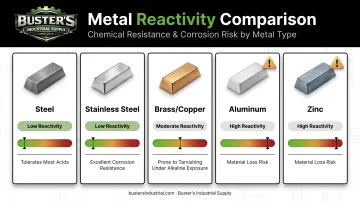
Different metals also tolerate these chemistries differently. Steel handles most acids fine. Aluminum and zinc are far more reactive and can lose significant material in the same bath that barely touches stainless steel. Brass and copper sit somewhere in between, prone to tarnishing under aggressive alkaline exposure.
From here, the top options for US industrial buyers stack up as follows.
Top Metal Cleaning Chemicals for Industrial Use
We ranked these on four criteria: cleaning performance across metal types, safety profile, supply reliability, and value at industrial volumes.
Buster's Industrial Supply
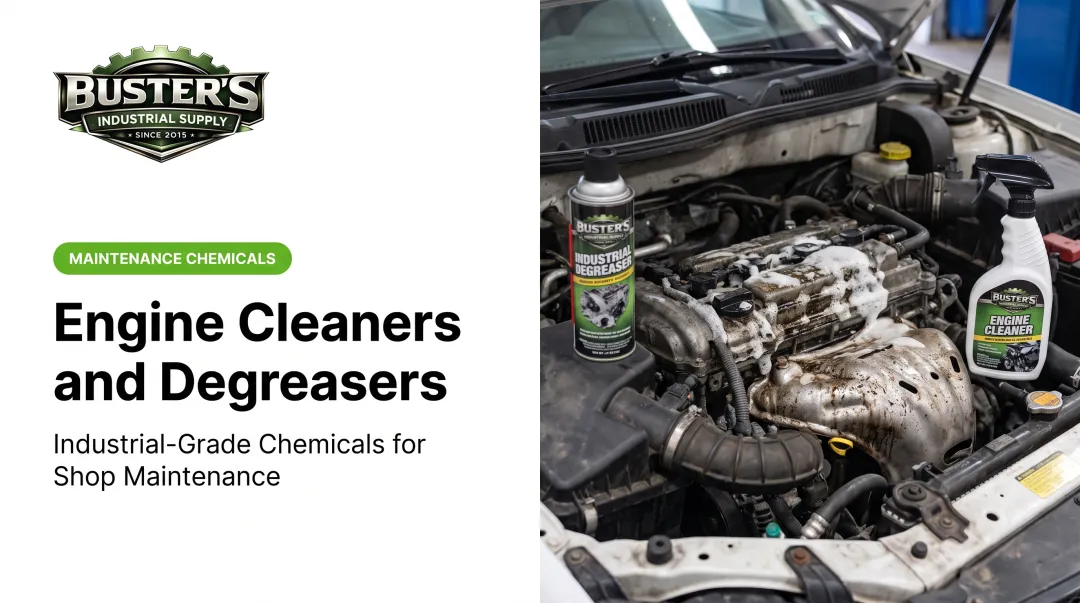
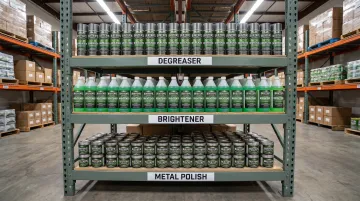
Buster's Industrial Supply operates as a one-stop shop carrying degreasers, brighteners, and metal polishes alongside the rest of a shop's MRO needs, so buyers aren't juggling five vendors for one supply closet.
The advantage is curated product selection plus a team that actually picks up the phone. Team Lead Jeff and owner Buster show up repeatedly in customer feedback for fast turnaround and genuine follow-through, not scripted support.
Most orders ship within 1-2 business days. Qualified accounts spending $500+ monthly get free on-site stocking with automatic replenishment before anything runs dry.
| Category | Details |
|---|---|
| Key Features | Zenafast 20oz Solvent Degreaser ($6.70/can); Premium Degreaser with Corrosion Protection ($232.90, 5- and 55-gal); Red Razer Heavy Duty Degreaser ($58.80, 5-gal); Alumax Plus Aluminum Brightener ($48.54); Mega Metal Polish ($75.00/gal) |
| Service Model | Rep-managed restocking; VMI for $500+/month accounts; quotes within 1 business day; no online minimum; tiered volume pricing on request |
| Best For | Shops that want one supplier for chemicals, tools, and consumables with hands-on restocking |
Zenafast alone carries a 4.9-star customer rating, and it's formulated to be residue-free on metals, which matters when parts go straight to paint or plating after cleaning.
Zep Inc.
Zep has manufactured industrial cleaning and degreasing chemicals in the US for decades, with a catalog broad enough to cover heavy-duty shop degreasing and food-safe environments in the same lineup.
Its distributor network is one of the widest in the category, meaning restocking rarely requires waiting on a single-source supplier.
| Category | Details |
|---|---|
| Key Features | Zep Industrial Purple Degreaser & Cleaner (heavy-duty alkaline); Zep Dyna 143 (solvent parts-washer fluid) |
| Technical Specs | Purple Degreaser runs pH 11.50; Dyna 143 is 90-100% hydrotreated light petroleum distillates, combustible |
| Best For | Parts washing, engine/tool cleaning, general manufacturing-equipment cleanup |
The Purple Degreaser's high pH makes it effective on stubborn grease, but its SDS flags severe skin and eye risk, so gloves and eye protection aren't optional.
CRC Industries
CRC built its reputation on maintenance-and-repair chemistry, with aerosol and bulk formats covering everything from electrical contacts to brake components.
Its corrosion-inhibitor formulations and MRO market presence make it a common name on shop shelves nationwide.
| Category | Details |
|---|---|
| Key Features | Quick Clean Safety Solvent Degreaser (aerosol, 5-gal, 55-gal drum); CO Contact Cleaner; Brakleen family |
| Technical Specs | Quick Clean and CO Contact Cleaner both report 0 g/L VOC with no flammability classification |
| Best For | Electrical contacts, machinery cleaning, brake and parts service |
Note that Brakleen's VOC and flammability rating varies by SKU — don't assume one product spec applies across the whole line.
Chemetall (Oakite Line)
Chemetall specializes in pretreatment chemistry for manufacturing and finishing operations, and its Oakite and Gardoclean lines show up frequently on plating and pre-paint lines.
The technical support that comes with these products is often as valuable as the chemistry itself for shops running finishing operations.
| Category | Details |
|---|---|
| Key Features | Gardoclean alkaline/acid/neutral cleaners; Oakite 33 (acidic multi-soil cleaner); Oakite Aluminum Cleaner 164 |
| Technical Specs | Oakite 33 runs below pH 2.0; controlled testing showed near-zero material loss on stainless steel versus significant loss on aluminum and zinc |
| Best For | Pre-plating and pre-paint surface prep across steel, stainless, and (with the inhibited aluminum-specific formula) aluminum |
Simple Green Pro Line
Simple Green Pro HD is the name most shops recognize first, largely because it's sold everywhere and doesn't require a hazmat placard to store.
Its water-based formula, built with biodegradable components, was originally developed for aircraft-industry use, which explains why it's tested across a wide range of sensitive materials.
| Category | Details |
|---|---|
| Key Features | Heavy-duty degreasing; compatible with metals, plastics, rubber, and high-tech alloys per manufacturer FAQ |
| Technical Specs | Archived SDS lists pH 10-11.5; no confirmed US EPA Safer Choice certification for this specific product |
| Best For | General shop degreasing, engine and tool cleanup, equipment maintenance |
It's not built for descaling or plating prep, but for everyday grease and grime removal in occupied shop spaces, it's a dependable, low-drama choice.
How to Choose the Right Metal Cleaning Chemical
Picking a cleaner off a shelf because it worked at your last shop is how pitted aluminum and ruined finishes happen. Run through this checklist instead.
Match Chemistry to Metal First
This is non-negotiable. Highly alkaline cleaners can stain or pit aluminum. Strong acids can eat into softer metals like brass or copper.
Cleaners formulated for stainless steel generally can't be assumed safe for aluminum. Check the SDS for your specific alloy before running a full batch.
Identify the Contaminant Before the Cleaner
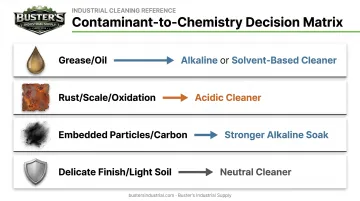
- Grease or oil → alkaline or solvent-based cleaner
- Rust, scale, or oxidation → acidic cleaner
- Embedded particles or carbon → stronger alkaline soak
- Delicate finish, light soil → neutral cleaner
Skip the Household Shortcuts
Vinegar and WD-40 work fine for a rusty hinge at home. They fall apart at industrial scale:
- Vinegar lacks the strength for heavy grease and can pit aluminum with extended contact
- WD-40 is a lubricant and moisture displacer, not a degreaser. It wasn't built for high-volume parts cleaning or corrosion removal on shop floors
These products aren't formulated for the throughput, corrosion protection, or contact time industrial jobs demand.
Factor in Safety and Compliance
- Prioritize low-VOC and biodegradable formulations to cut worker exposure and disposal costs
- Confirm SDS documentation meets OSHA Hazard Communication requirements
- Check whether spent solvent qualifies as hazardous waste under EPA rules before disposal
Factor in Supplier Reliability
A cleaner that works is only useful if you can get more of it before your line goes down. A supplier who answers the phone and knows your account, the way Buster's Industrial Supply's team does for repeat customers, beats a one-off retail run every time production schedules are tight.
Conclusion
The best metal cleaning chemical is the one matched to your metal, your contaminant, and your shop's safety requirements—not simply the most popular product on the shelf.
Before committing to a chemical program, weigh cost-effectiveness, compliance, and how quickly your supplier responds when you need a refill fast. Getting all three right saves far more in rework than any product label promises upfront.
Not sure which chemistry fits your shop? Contact Buster's Industrial Supply or call 817-367-9101 (Monday-Friday, 7:30 AM-5:00 PM CT) for help sourcing the right metal cleaning chemicals for your operation.
Frequently Asked Questions
What is the best chemical for cleaning metal?
It depends on your metal and soil type. Alkaline cleaners handle grease and oil, while acidic cleaners target rust and scale. Matching chemistry to the substrate matters more than brand.
What should I not use to clean metal?
Avoid abrasive tools, chlorine bleach, and strong acids on reactive metals like aluminum. These can cause pitting, discoloration, or lasting structural damage rather than a clean surface.
Is vinegar okay for cleaning metal?
Vinegar can handle light rust or tarnish on select metals but should be rinsed off promptly. Research shows acetic acid increases surface dissolution on aluminum, so avoid it on untreated aluminum and don't rely on it for heavy industrial soils.
Is WD-40 good for cleaning metal?
WD-40 works well for light lubrication, moisture displacement, and loosening light grime. It isn't formulated as a heavy-duty degreaser or rust remover for industrial-scale cleaning needs.
How do you clean metal without causing rust or damage?
Use a pH-matched cleaner for your specific metal, rinse thoroughly to remove residue, and dry parts promptly. Apply a corrosion inhibitor or protective coating afterward if parts will sit before further processing.
Are industrial metal cleaning chemicals safe to use indoors?
Many modern water-based, low-VOC formulations are safe indoors with proper ventilation. Solvent-based products typically require additional PPE and airflow controls, so always check the SDS first.